

Hello.
I am Dr. Kim Dong-young, Director of Cleor Clinic Hongdae Branch.
Have you ever been bothered by dark circles under your eyes when looking in the mirror,
or felt that your face looks flat because your cheeks have lost their volume?
"I've looked into lifting, but there are so many types of threads that I don't know which one is right for me.
I've heard there are threads for pulling and threads for filling.
I feel like my face is more sunken than sagging, so which one should I get?"
I frequently receive these inquiries in my consultation room.
Even for the same lifting procedure, the approach differs completely depending on the direction of facial aging.
If your jawline is sagging or your facial contours look collapsed, a pulling lifting procedure is suitable.
However, if the area under your eyes is sunken and dark, or your cheeks are flat, making your face look dull,
a filling lifting approach is necessary for a fundamental solution.
This filling-oriented lifting is the Hongdae Jamber Thread Lifting.
Today, I will explain how sagging and sinking differ, how Jamber Thread differs from pulling threads,
and which areas are suitable for Jamber Eye and Jamber Volume threads.
What is Hongdae Jamber Thread Lifting?

👉 Hongdae Jamber Thread Lifting is a filling-type thread lifting that uses PDO (polydioxanone) threads tightly wound in a spring shape to fill the skin under sunken areas,
restoring volume and inducing collagen regeneration.
General thread lifting uses threads with barbs (cogs) on the surface,
which hook onto tissue to pull it in one direction.
Jamber Thread is completely different from this method.
It has a dense spring structure without barbs,
allowing it to settle within the sunken space,
three-dimensionally wrapping the tissue and pushing the volume up.
Because it approaches the issue through filling rather than pulling,
it is a suitable procedure for facial aging caused by sinking and depression.
Sagging and Sinking are Completely Different Types of Facial Aging
👉 Facial aging is broadly divided into sagging, where tissue stretches downward, and sinking, where it collapses inward.
These two types of aging require completely different approaches and procedures.
Sagging - Aging where tissue stretches in the direction of gravity
A sagging jawline or collapsed side facial lines are typical signs of sagging aging.
As the supporting ligaments weaken, the entire facial tissue cannot overcome gravity and shifts downward,
so a pulling lifting approach to lift it upward is the fundamental solution.
General cog thread lifting or ultrasound/radiofrequency lifting is suitable for this.
Sinking - Aging where tissue collapses inward
Sunken, dark areas under the eyes or flat central cheeks that make the face look dull are signs of sinking aging.
As fat and collagen under the skin decrease, the space collapses inward,
so a pulling method will not solve this and may even look unnatural.
An approach that fills the sunken space is the fundamental solution, and Jamber Thread Lifting is suitable for this direction.
Often, both types of aging occur together
After the age of 40, it is common for both sagging and sinking to progress simultaneously.
In such cases, a combination of pulling and filling procedures is often considered,
and which aging type takes priority is determined during the pre-procedure consultation.
Cog Thread (Pulling Thread) vs. Jamber Thread (Filling Thread)
👉 Not all thread lifting procedures are the same; they are broadly divided into pulling and filling methods based on the thread surface structure and insertion method,
and the suitable facial areas and purposes are completely different.
Cog Thread - Pulling-type thread lifting
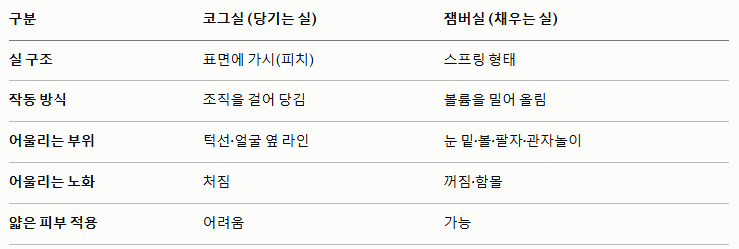
The thread surface has barbs (cogs) that hook onto tissue to pull it upward.
Since it lifts sagging areas like the jawline or side facial lines upward,
it is strong in contouring and restoring facial lines.
However, because it is a strong pulling method, it is difficult to apply to thin and sensitive areas like under the eyes,
and it does not have a significant effect on filling sunken spaces.
Jamber Thread - Filling-type thread lifting
This is a thread with a dense spring structure without barbs.
When inserted into a sunken space, the spring settles, three-dimensionally wrapping the tissue,
and works by pushing the volume up from the inside.
Because it fills rather than pulls, it can be used in sensitive areas like under the eyes,
and it is characterized by volume restoration and collagen regeneration induction.
Since the two procedures have different principles, if you have both sagging and sinking,
combining them can create synergy.
Decision Guide for Jamber Eye and Jamber Volume Thread Areas
👉 Jamber Eye and Jamber Volume threads used at the Hongdae branch have the same spring structure but differ in elasticity and thickness,
so the suitable areas and purposes are clearly divided.
Jamber Eye - Low-elasticity thread exclusively for under the eyes

The area around the eyes has the thinnest skin on the face and is densely packed with blood vessels and nerves.
Applying the elasticity of a general thread would cause too much irritation and burden,
so Jamber Eye is designed with lower elasticity and a blunt cannula tip for this area.
Suitable areas: Under-eye sinking/tear troughs / fine lines around the eyes / under-eye fat (aegyo-sal) volume supplementation
Appropriate number of threads: Usually 2-4 threads are used due to the small area
4 threads are often chosen for deep tear troughs or when treating both sides
Jamber Volume Thread - High-elasticity thread for cheeks, nasolabial folds, and temples
This is a high-elasticity spring structure with a 40cm thread tightly compressed.
It is specialized for creating three-dimensional volume in wide areas,
making it suitable for sunken areas with large surface areas like cheeks, nasolabial folds, and temples.
It has a large contact area with skin tissue, providing stable collagen regeneration effects.
Suitable areas: Central cheek depression (front/side cheeks) / deep nasolabial folds / temple sinking / Indian bands
Appropriate number of threads: 2-4 threads are often chosen depending on the area range and degree of sinking
4 threads are stable when treating both cheeks and nasolabial folds.
Combining both threads
If you have both under-eye and cheek sinking, a combination of Jamber Eye and Jamber Volume threads
is frequently used.
As volume is restored in both areas through the spring structure,
the overall facial impression becomes brighter and more three-dimensionally defined.
Hongdae Jamber Thread Lifting Lineup
👉 At the Hongdae branch, we offer 2-thread and 4-thread options for both Jamber Eye and Jamber Volume threads, allowing you to choose according to the treatment area.
You can see the volume immediately after the procedure, but there is initial swelling,

so you can confirm stable results at the 2-4 week mark.
The threads slowly dissolve in the body over about 6 months,
and the maintenance period is on average 10-14 months.
Even after the threads have completely dissolved, the collagen regeneration effect remains,
settling in a way that maintains a certain level of volume.
The type and number of threads suitable for your degree of sinking and treatment area
will be examined together during the pre-procedure consultation.
Who is Jamber Thread Lifting suitable for?
Those whose under-eye area is sunken, making it look dark like dark circles
Those whose tear troughs are deep, making them look tired
Those whose central cheeks have flattened, making their face look dull
Those concerned about the depth of their nasolabial folds
Those who feel that cog thread lifting does not match their facial aging direction
Those who want natural volume restoration rather than the immediate filling of fillers
Side Effects and Things to Know in Advance about Hongdae Jamber Thread Lifting
👉 Hongdae Jamber Thread Lifting uses a soft cannula-type thread, making it a relatively low-burden procedure,
but reactions may vary depending on individual skin conditions and treatment areas.
Immediately after the procedure, light redness, minor swelling, and thin bruising may occur for a few days.
Generally, this resolves naturally within a few days to a week.
Jamber Thread has no barbs and uses a cannula insertion, so the burden is lower than general cog threads,
but swelling and thin bruising should be expected when treating areas around the eyes or sensitive areas.
Initial swelling for 2-4 weeks after the procedure may make it difficult to judge the results,
so it is accurate to check the final results once the area has stabilized.
Following the guidance of experienced medical staff during the pre-procedure consultation,
the type and number of threads suitable for your facial aging direction and area condition will be determined.
If any of the following apply to you, the procedure may be restricted or
prior confirmation may be required, so please inform us during the consultation.
If you are pregnant or breastfeeding
If you have active infections, wounds, or herpes in the treatment area
If you have a keloid tendency or autoimmune diseases
If you are regularly taking anticoagulants/antiplatelet agents or have a bleeding tendency
If you have a history of filler or other thread procedures in the treatment area recently
If you have an important schedule within 2 weeks (swelling stabilization period required)
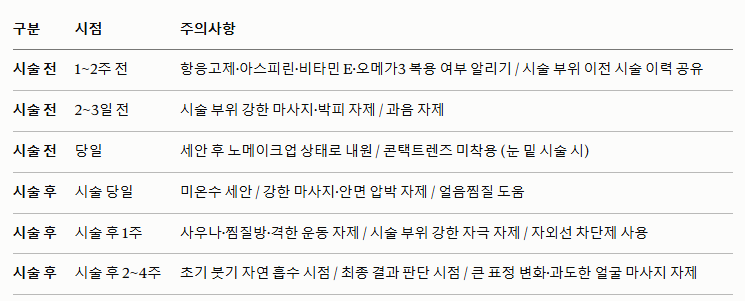
⚠️ Precautions before and after Jamber Thread Lifting
👉 Jamber Thread Lifting is a procedure where result stability and recovery speed depend on pre-procedure condition management and post-procedure facial irritation management.
❓ Frequently Asked Questions (FAQ)
Q. How long does the Hongdae Jamber Thread Lifting last?
The threads themselves slowly dissolve in the body over about 6 months,
and the average maintenance period is about 10-14 months.
Even after the threads have completely dissolved, the collagen regeneration effect remains,
settling in a way that maintains a certain level of volume.
Q. How is a re-procedure performed after the maintenance period?
Re-procedure is possible after 6 months when the existing threads have completely dissolved,
and most people consider re-procedure around the 1-year mark.
The suitable direction is determined after checking previous procedure history and collagen regeneration status during the pre-procedure consultation.
Q. Can I get fillers and Jamber threads together?
Yes, it is possible.
When Jamber threads settle first, the spring structure stably fixes the filler,
creating synergy that helps the volume last longer.
If you proceed with both, the order and interval will be determined during the consultation.
Q. Can I get it with cog thread lifting?
If you have both sagging and sinking, a combination is frequently used.
Cog threads lift sagging facial lines upward,
and Jamber threads restore volume in sunken areas,
so there is synergy as the two procedure principles do not overlap.
Q. How much pain is there during the procedure?
It is performed after sufficient application of numbing cream, so there is no severe pain.
Since it uses a soft cannula-type thread, you may feel pressure during insertion,
and there are individual differences in perceived pain depending on sensitivity.
Q. When can I see the results after the procedure?
Some people feel volume changes immediately after the procedure, but there is initial swelling,
so you can confirm stable results at the 2-4 week mark.
Collagen regeneration effects accumulate gradually even after that.
Q. Do the threads move inside the body or cause problems?
Jamber threads are made of PDO, a verified material that safely dissolves in the body,
and once the spring structure settles within the tissue, it does not move easily.
If you follow the post-procedure management guidelines, they will settle stably.
Q. My under-eye area is very sensitive; can I get Jamber Eye?
Jamber Eye is a thread exclusively for under the eyes, designed with lower elasticity for thin skin around the eyes
and a blunt cannula tip.
It is a structure that minimizes vascular irritation, so it can be used in sensitive areas around the eyes,
and it is performed after checking individual skin conditions during the pre-procedure consultation.
Facial aging progresses in two completely different directions: sagging and sinking,

and the lifting approaches suitable for each are also completely different.
While pulling cog thread lifting is suitable for sagging where the jawline or side facial lines stretch downward,
a filling-type approach is the fundamental solution for sinking where the area under the eyes becomes dark and cheeks become flat.
Hongdae Jamber Thread Lifting is a filling-type thread lifting that fills sunken spaces with spring-shaped PDO threads,
pushing volume up from the inside and inducing collagen regeneration.
At the Hongdae branch, we operate with 2-thread and 4-thread options for both Jamber Eye threads for under the eyes and Jamber Volume threads for cheeks, nasolabial folds, and temples.
If under-eye sinking is your main concern, Jamber Eye is suitable,
if cheek and nasolabial fold depression is your main concern, Jamber Volume thread is suitable,
and if you need care for both areas, a combination is frequently used.
The direction that matches your facial aging direction and management goals
will be confirmed in person during the consultation.
If your concern is sinking rather than sagging,
please feel free to visit Cleor Clinic Hongdae Branch.
Even before deciding on a procedure, you can examine your current facial condition
and the types of threads that suit you through a pre-procedure consultation.
※ This content is for general information purposes only, and results may vary by individual.
Please decide on accurate diagnosis and procedure through consultation with a specialist.
※ 본 내용은 일반적인 정보 제공을 위한 글이며, 개인에 따라 결과는 달라질 수 있습니다.
정확한 진단과 시술 여부는 전문의 상담을 통해 결정하시기 바랍니다.