

Hello.
I am Kim Dong-young, Director of Cleor Clinic Hongdae Branch.
There are days when the makeup you carefully applied in the morning looks different by the afternoon.
It is not that the base has smudged, but rather that if there are fine irregularities on the surface,
the product gathers inside them, making the edges appear more defined.
This is also why it looks fine from a distance but becomes noticeable only when the light hits from the side.
In such areas, there are usually two things present together.
Marks where the dermis did not fill in as before after acne has passed,
and the remaining pigmentation in those spots, which makes the shadows of the irregularities appear darker.
Since one is a problem of depth and the other is a problem of color,
it is a difficult area to address all at once with a single method.
When you look into Fraxel, you will find several items with similar names.
Pico Fraxel, Erbium Fraxel, and Picosure Fraxel.
Today, I will explain how Picosure Fraxel is operated at our Hongdae branch,
and how it differs from existing Pico Fraxel, step by step.
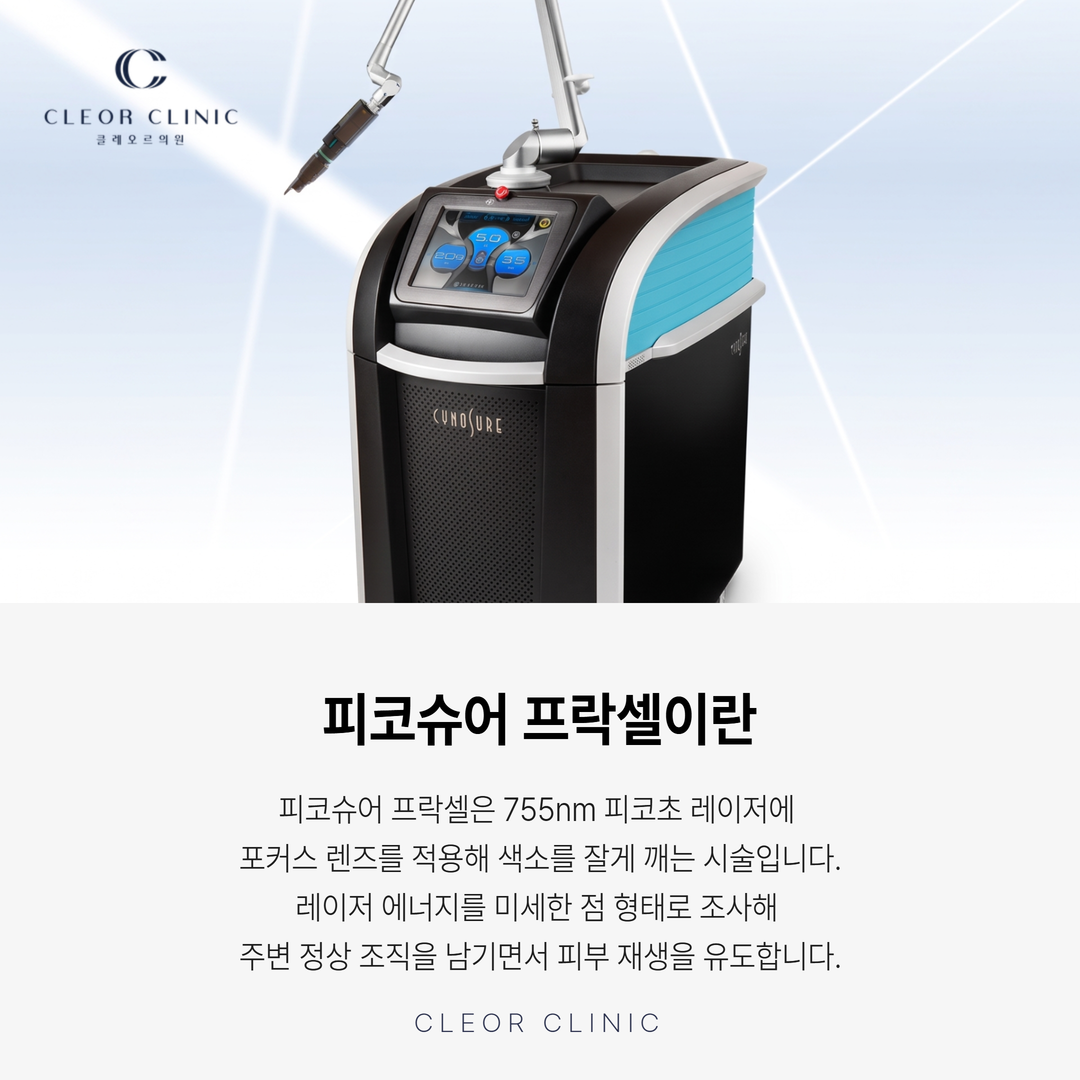
What is Picosure Fraxel?
👉 Picosure Fraxel uses a 755nm Alexandrite picosecond laser
fitted with a focus lens to concentrate energy into points to break down pigmentation.
The name is composed of three parts.
Pico refers to the time the energy stays at one point,
meaning the pulse duration is short, in the picosecond range.
Even with the same intensity, if it enters in a short time, the proportion of heat spreading to the surroundings decreases,
and it is explained that the proportion of photoacoustic action, which is an instantaneous pressure wave, increases.
Picosure is a picosecond laser that uses a 755nm Alexandrite wavelength.
Fraxel is an operational method that delivers energy in a divided manner.
Instead of passing over the face surface all at once, it applies stimulation only in fine points,
leaving the untouched tissue between the points intact.
Strengths of Picosure Fraxel
👉 The two conditions of wavelength and lens overlap, allowing you to plan for both color and depth in one direction.
First, it is the 755nm wavelength.
The degree to which light is absorbed by melanin varies depending on the wavelength.
755nm is known to be a wavelength range with a high melanin absorption rate,
so it is suitable for targeting pigment clusters on the epidermis.
This is the reason why this wavelength comes to mind first when pigmentation and marks are mixed in one place.
Second, the focus lens is the method of creating points.
When passing through the lens array, the beam that was spreading evenly
is re-concentrated into multiple high-intensity points.
At the concentrated points, very small destruction points are created within the dermis,
and the skin recognizes those areas as places to be restored and begins to create new collagen.
It is not a method of creating points by shaving the surface, but a method of creating points inside by concentrating light.
Third, it is the arrangement of intentionally leaving untouched tissue.
If a wide area is stimulated all at once, the reference point for starting recovery disappears.
On the other hand, if you leave untouched tissue between the points,
that tissue acts as a starting point and recovery spreads toward the surroundings.
This is why the time and burden required for recovery differ depending on whether the same stimulation is given as a surface or divided into points.
Differences from existing Pico Fraxel
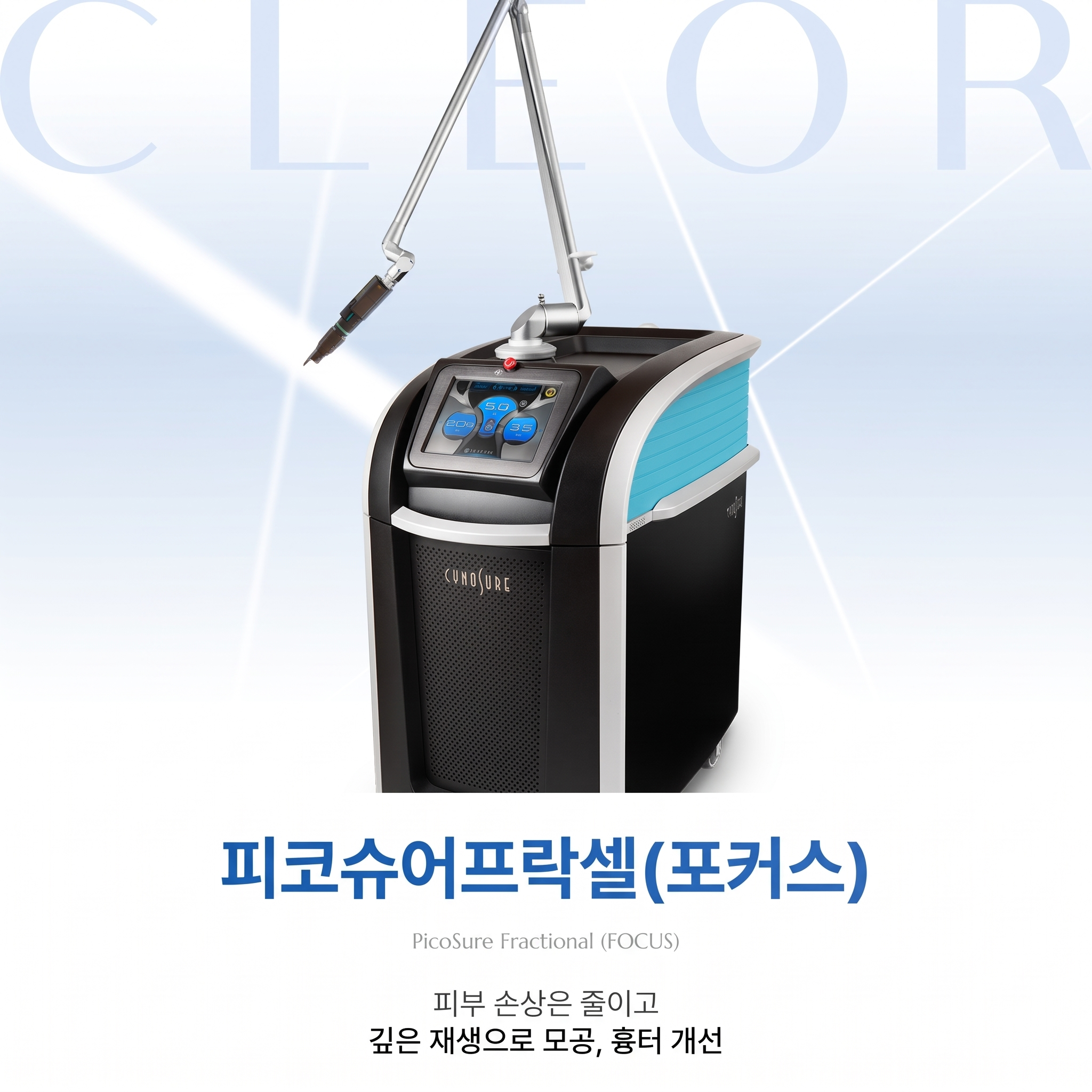
👉 Both create points with a picosecond laser, but the wavelength used to create the points and the device used to create them are different.
The term Pico Fraxel generally refers to the operation of using a picosecond laser in a fractional manner.

Usually, 1064nm and 532nm series are used; 1064nm has low melanin absorption but
goes deeper, while 532nm leaves most of its effect in shallow areas.
Therefore, the weight tends to be on depth and unevenness.
Picosure uses only 755nm.
It is a wavelength range with high melanin absorption, so it is suitable for epidermal pigmentation,
and by attaching a focus lens here, it creates destruction points within the dermis.
It is closer to dealing with color and depth within one wavelength.
It is not about which wavelength is better, but that the target areas are different.
If it is a mark with pigmentation, it leans toward 755nm,
and if deep unevenness is the main concern, other wavelengths are considered.
What is the principle of action?
👉 Light concentrated into points plants small destruction points inside, and the intact tissue left in between leads the recovery.
Light concentrated through the lens creates fine destruction points within the dermis.
The skin recognizes these points as areas that need to be restored,
and the process of fibroblasts in the dermis creating new collagen begins.
The irregularities caused by the dermis not being filled after acne has passed
are treated in a direction where they are gradually filled up as this process is repeated.
At this time, the tissue left between the points plays a big role.
If intact tissue surrounds the destruction points, the cells and substances needed for recovery
are supplied from a close distance, so regeneration proceeds quickly.
This is why the arrangement of leaving untouched areas is a strategy, not a loss.
Pigmentation follows a different path.
When 755nm is absorbed by pigment clusters on the epidermis, the energy that entered in a short time
turns into an instantaneous pressure wave, scattering the pigment clusters into small pieces.
The finely divided pigment goes through a process where the body processes and expels it.
Equipment and programs used
👉 The basis of this method is to concentrate energy into points rather than a surface and intentionally leave untouched skin.
At Cleor Clinic Hongdae Branch, we divide the composition based on whether to narrow the range or go for the entire face,
and whether to view it as one session or divide the sessions.

Instead of increasing the density of points in one session, we use an operation of passing over the same area
multiple times by dividing the sessions, because if you increase the density too much at once,
the portion left behind decreases, and the room to rely on for recovery also decreases.
How to set the density and sessions depends on the depth of the irregularities and the speed of recovery.
Whether to view it as a partial area or the entire face, and whether to follow up with Potenza,
is decided after checking the skin thickness and the location of the marks.
These skin types are worth considering
Those who are bothered by base makeup settling into indented areas in the afternoon
Those who have fine irregularities and pigmentation caused by acne marks mixed in one area
Those who want to plan for pigmentation as well
Those who want to look at methods with less burden than those that remove the surface
Those who prefer to divide the sessions and continue rather than having a strong treatment at once
Types of pigmentation and irregularity lasers in Hongdae
👉 Even within the same laser series, the properties differ depending on whether the energy is spread as a surface or concentrated as points.
Which combination is suitable depends on the depth of the irregularities, the layer where the pigment is located,
and skin sensitivity, so we adjust while observing the reaction.

Things to know in advance
👉 Since it is a care that goes through a regeneration process, how well you moisturize and block UV rays during the recovery period greatly influences the subsequent progress.
⚠️ Pre- and post-treatment precautions
❓ Frequently Asked Questions (FAQ)

Q. How is it different from Pico Fraxel?

A. Both create points with a picosecond laser, but the wavelength used and the device used to create the points are different.
Picosure is an operation that concentrates 755nm with a focus lens,
and the term Pico Fraxel generally refers to the operation of using 1064nm and 532nm series in a fractional manner.
It depends on whether it is a mark with pigmentation or if depth is the main concern.
Q. Why is it shot in divided points instead of the whole face?
A. To leave untouched tissue between the points.
The remaining tissue acts as a starting point for recovery to begin,
supplying what is needed for restoration from a close distance.
Therefore, the time and burden required for recovery differ even with the same stimulation.
Q. Can pigmentation and irregularities be treated together?
A. Since it is a method that uses a wavelength with high melanin absorption and creates points inside with a lens,
the two can be targeted separately in one direction.
However, the emphasis on which side to focus on is set differently after seeing the skin condition.
Q. Is it a method of shaving off the skin surface?
A. No.
It is a non-ablative method that does not remove the epidermal surface,
so it sends stimulation below the surface while maintaining the surface that acts as a barrier.
This is also why it is possible to operate by dividing sessions while lowering the burden of the recovery period.
Q. Can I proceed if I have sensitive skin?
A. We consider starting by lowering the density and intensity of the points.
We check the skin condition and redness tendency on the day of the procedure before deciding whether to proceed and setting the parameters.
Q. Can I receive it in the summer?
A. How well you block UV rays is more important than the season.
As it uses a wavelength with high melanin absorption, we sometimes adjust the timing
if a schedule where blocking management is difficult is planned.
Picosure Fraxel in Hongdae is not a concept of covering the surface,
but a care in the direction of concentrating 755nm with a lens to plant points inside,
and letting the tissue left in between lead the recovery.
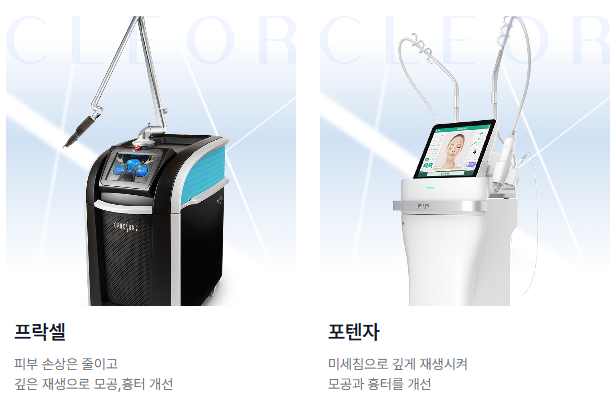
Because it is a wavelength with high melanin absorption, it targets the color of the surface,
while the destruction points created by the lens deal with the irregularities inside, and it proceeds without removing the surface,
maintaining the barrier.
At Cleor Clinic Hongdae Branch, we check the depth of the irregularities, the layer where the pigment is located,
and skin sensitivity together to confirm during consultation whether this direction is suitable.
If it is a case where pigmentation needs to be addressed first, we also operate items such as Pico Dual Toning or
Laser Toning, so we sometimes divide the order.
If you have been bothered in front of the mirror every afternoon, it would be good to talk about it comfortably.
※ This content is for general information purposes, and changes that appear may vary depending on the individual.
Please judge the exact diagnosis and whether to proceed with the procedure through consultation with a specialist.
오후마다 거울 앞에서 신경 쓰이셨다면, 편하게 한 번 이야기 나눠 보셔도 좋겠습니다.
※ 본 내용은 일반적인 정보 제공을 위한 글이며, 개인에 따라 나타나는 변화는 달라질 수 있습니다.
정확한 진단과 시술 여부는 전문의 상담을 통해 판단하시기 바랍니다.