
Hello.
I am Dr. Kim Dong-young, Director of Cleor Clinic Hongdae Branch.
Have you ever found yourself looking closely at your face in a bathroom mirror under particularly bright lighting?
Sometimes, pores next to the nose that were once round suddenly look like elongated ovals, and when light falls from above, they can appear even longer due to the shadows cast inside them.
At this point, many people first try to scrub the surface more thoroughly.
They change their cleansing routine or increase the use of exfoliating products, but the area around the nose quickly becomes oily again, and the visibility of the pores does not change significantly.
There is a reason for this.
This is because there are usually two overlapping factors behind why pores look enlarged.
Today, we will look at what those two factors are, and how the Hongdae pore laser approaches them in order.
What is the Hongdae pore laser?
👉 The Hongdae pore laser is a treatment that creates microscopic heat columns in the dermis, causing the skin to recognize those areas as targets for repair, and inducing the creation of tissue that supports the pores from the inside during the recovery process.
The first reason pores look enlarged is sebum.
Areas where a lot of sebum is produced keep the pore openings, which act as passages, in a constantly dilated state.
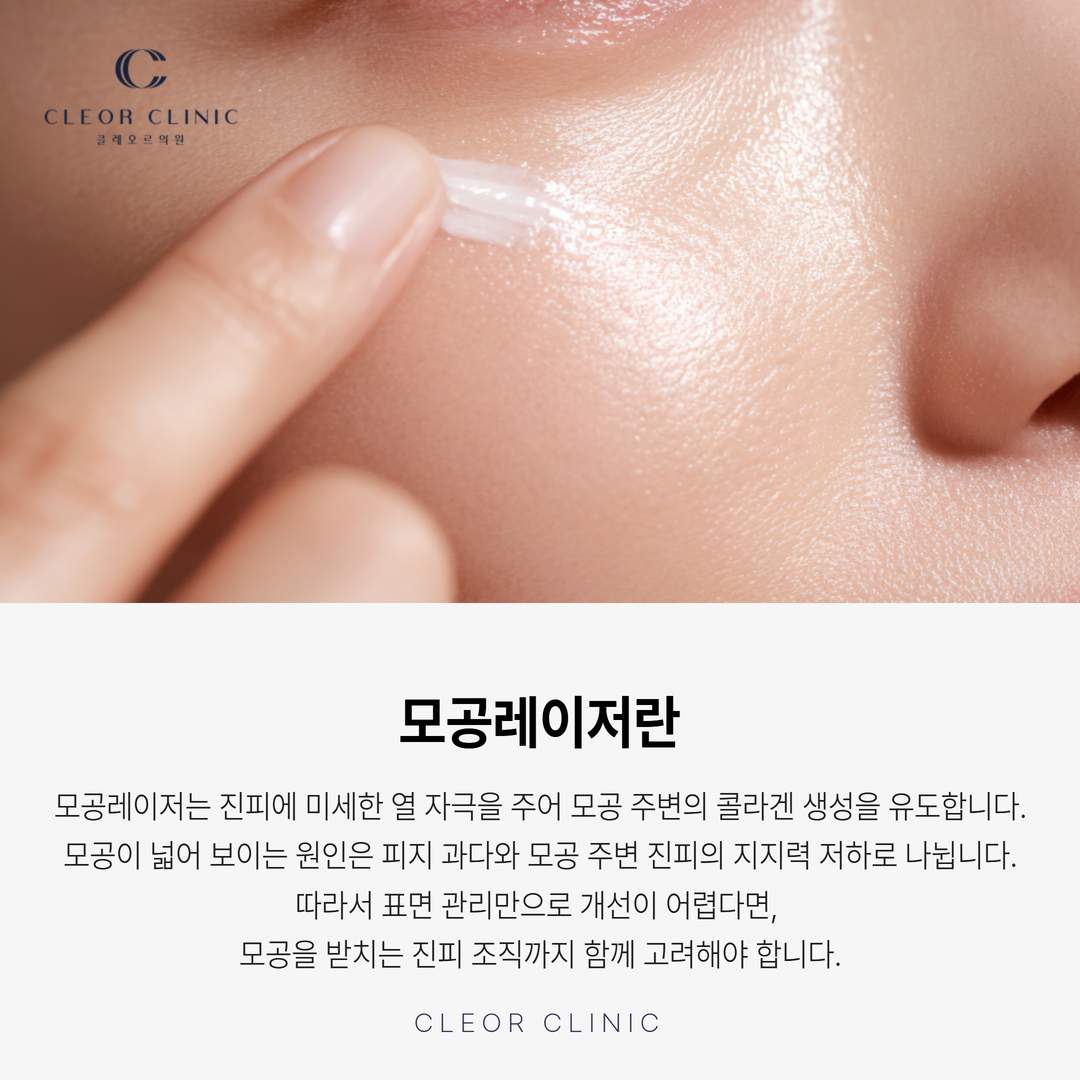
This is why pores are most noticeable in areas where sebaceous glands are concentrated, such as the nose, the area next to the nose, and the forehead.
The second reason is structural support.
Pores are not just open holes; they are structures supported by the surrounding dermal tissue.
When the amount and arrangement of the collagen that makes up this tissue change and the supporting strength decreases, the opening sags downward, making the once-round shape appear as a vertically long oval.
This is where an important point arises.
Approaches that scrub the surface reach the first factor, but they do not reach the second factor.
If the visibility of your pores has not changed significantly despite increasing your cleansing and exfoliation, it is usually because the second factor is also present.
Strengths of the Hongdae pore laser
👉 The greatest strength of the Hongdae pore laser is that it does not just refine the surface, but activates the skin's own recovery process to create tissue that supports from the inside.
First, it reaches the dermis, which surface care cannot reach.
When laser energy is absorbed into the skin, microscopic heat columns are created in those areas. Because it is a method that leaves heat only in a narrow range while leaving the surrounding tissue intact, the skin recognizes these areas as targets that need to be repaired. It works on a completely different layer than methods that physically strip the surface.
Second, the collagen created during the recovery process supports the pore circumference from the inside.
When the skin recognizes damage, an inflammatory response occurs first, gathering the cells necessary for recovery, and then fibroblasts create new collagen. Afterward, the created tissue takes time to rearrange and settle. In this process, the sagging pore circumference is supported from the inside, changing the direction so that the opening appears less dilated.
It is a method of creating support from below rather than covering from above.
Third, it is easy to adjust because it is built up thinly with each session.
Because it is not a method of applying strong force all at once, but rather proceeding in sessions, we can set different conditions for areas with a lot of sebum, like the sides of the nose, and areas with thin skin, like the cheeks. It is a method of checking how the skin reacts after the procedure and then adjusting the next intensity and interval, so we operate by dividing the face into different areas.
Operating principle of the Hongdae pore laser
👉 The principle of the Hongdae pore laser lies in intentionally triggering the recovery process that the skin activates when it recognizes damage.
When the skin is wounded, it enters a recovery process in a set order.
First, in the inflammatory response stage, cells necessary for recovery gather at the site; next, fibroblasts are activated to create new tissue; and finally, the created tissue is organized and rearranged over time.
The microscopic heat columns created by the laser are the stimulus to trigger this sequence.At the center of the tissue created at this time is collagen.
If the pores looked enlarged because the amount and arrangement of the collagen supporting the pore circumference had changed, the newly created collagen supports that area from the inside, leading to a reduction in the degree of sagging.
It is accurate to understand it as a direction where the wall surrounding the hole becomes firm again, rather than filling the hole.
However, this process requires time.
Because it takes time for tissue to be created and rearranged, it is difficult to judge based only on the appearance immediately after the procedure.
This is why a plan of dividing sessions and building up thinly is recommended, and why a separate plan for managing sebum secretion conditions is also included.Equipment and programs for the Hongdae pore laser
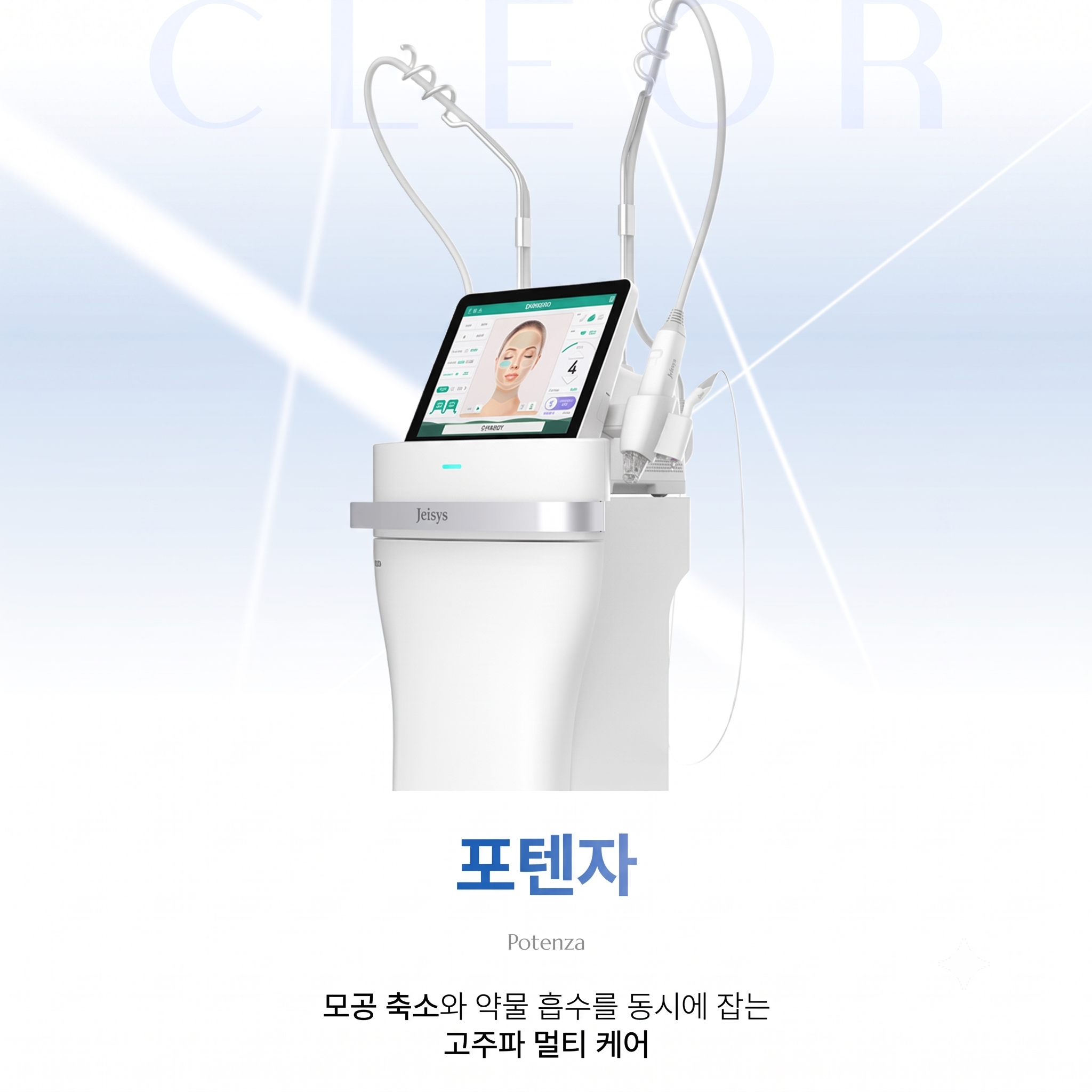
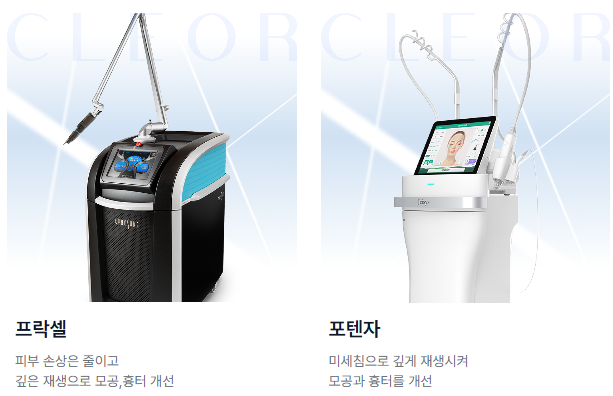
👉 At Cleor Clinic Hongdae Branch, we use Potenza for pore reduction, and we divide the sessions into a configuration that uses both needles and radiofrequency.
Potenza is a device that sends microscopic needles down to the dermis and then emits radiofrequency heat from the tips of the needles.
It can pass through the surface and create heat only at the desired depth, making it a configuration that places stimulation on the lower layers while reducing the burden on the outer layers.
If you change the tip to a pumping tip, it pushes ingredients along the path created by the needles. This is where the configuration of following up with skin boosters like Rejuran, Juvelook, or exosomes in the same spot comes from.
We also plan to use Pico Fraxel, which divides energy into points on the same axis.
Even with the same Potenza, the area where the action is concentrated changes depending on the needle depth and the time the heat is applied.
We decide which combination to use after checking the amount of sebum and skin thickness.Who is the Hongdae pore laser for?
Those who are bothered by pores next to the nose looking vertically long under bright lighting.
Those who feel that their cheek pores look enlarged and their skin looks more saggy than before.
Those who have tried increasing cleansing and exfoliation but feel that changes are slow.
Those who feel that their makeup breaks down easily due to excessive sebum secretion.
Those who prefer a direction that continues in divided sessions.
Types of Hongdae lasers
👉 Since there is not just one cause for pores, the items we look at together are also divided into several axes.
The options mentioned along with the Hongdae pore laser among the items operated at Cleor Clinic Hongdae Branch are summarized by category below.
Which combination is appropriate depends on the amount of sebum, elasticity, and skin thickness.
Rather than fixing it to one thing, we tend to adjust it while watching the reaction.
Side effects and things to know in advance about the Hongdae pore laser
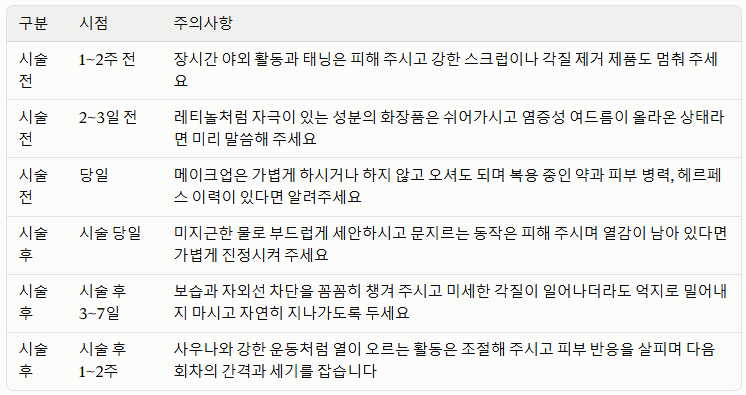
👉 The Hongdae pore laser is a treatment that involves heat stimulation, so soothing care and UV protection after the procedure have a significant effect on the subsequent progress.
It is also good to know in advance that this is not a concept where pores disappear.
Pores are passages through which sebum escapes and are not structures that can be eliminated, so if the sebum secretion conditions remain the same, a plan to continue management together is necessary.
⚠️ Precautions before and after the Hongdae pore laser procedure
❓ Frequently Asked Questions (FAQ)
Q. Even if I wash my face diligently, nothing changes. How is the Hongdae pore laser different?
A. Cleansing and exfoliation are approaches to tidying up sebum and dead skin cells accumulated at the pore opening. On the other hand, since they do not reach the situation where the support of the dermal tissue supporting the pore circumference has decreased, we approach it in a direction that triggers the recovery process by giving heat stimulation to the dermis.
Q. Do pores disappear if I get the Hongdae pore laser?
A. Pores are passages through which sebum escapes and are not structures that can be eliminated. You can understand it as a treatment planned with the goal of making them less noticeable by supporting the circumference from the inside.
Q. Why don't you do the Hongdae pore laser strongly at once?
A. It takes time for tissue to be created and rearranged. We recommend this operation because it is easier to adjust the intensity and interval while watching the reaction if you build it up thinly with each session.
Q. I have a lot of blackheads. Can I treat them together with the Hongdae pore laser?
A. Blackheads are closer to the form of oxidized sebum accumulated on the surface, so the axis of approach is different. We often plan it together with surface-refining care like Aqua Peel.
Q. Why does redness occur after the Hongdae pore laser?
A. This is because an inflammatory response, the first stage, occurs as the skin reacts to the heat stimulation left in the dermis with a recovery process. It is closer to a signal that recovery is in progress and usually subsides.
Q. How do you set the interval between Hongdae pore laser sessions?
A. The period it takes for tissue to be organized varies from person to person, so we do not define the number of days. It is a method of adjusting the next schedule while checking how the skin reacts after the procedure.
The Hongdae pore laser is a treatment that targets the area that could not be reached by approaches that scrub the surface, that is, the dermal tissue that supports the pore circumference.
As the skin reacts to the microscopic heat columns left in the dermis with a recovery process, new collagen is created, and that tissue supports the pore circumference from the inside, changing the direction so that the opening appears less dilated.
It is not a method of changing things significantly at once, but an operation of building up thinly with each session, so it is easy to set different conditions for each area.
At Cleor Clinic Hongdae Branch, we examine the amount of sebum, elasticity, and areas where pores look enlarged together to confirm directly during consultation whether this direction is appropriate.

If fine irregularities are mixed in, we also look at Pico Fraxel as a follow-up.
If the same area has been bothering you every time you look closely in the mirror, please feel free to talk to us about it.
※ This content is for general information purposes, and changes may vary depending on the individual.
Please determine the exact diagnosis and whether to proceed with the procedure through consultation with a specialist.
밝은 조명 아래에서 코 옆 모공이 세로로 길어 보여 신경 쓰이시는 분
볼 모공이 넓어 보이면서 피부가 예전보다 처져 보인다고 느끼시는 분
세안과 각질 관리를 늘려 봤지만 변화가 더디다고 느껴 오신 분
피지 분비가 많아 화장이 잘 무너진다고 느끼시는 분
회차를 나누어 이어가는 방향을 선호하시는 분
홍대 레이저 종류
👉 모공은 원인이 한 갈래가 아니라 함께 두고 보는 항목도 여러 축으로 나뉩니다.
클레오르의원 홍대점에서 운영 중인 항목 가운데 홍대 모공레이저와 함께 언급되는 선택지를 성격별로 정리하면 아래와 같습니다.
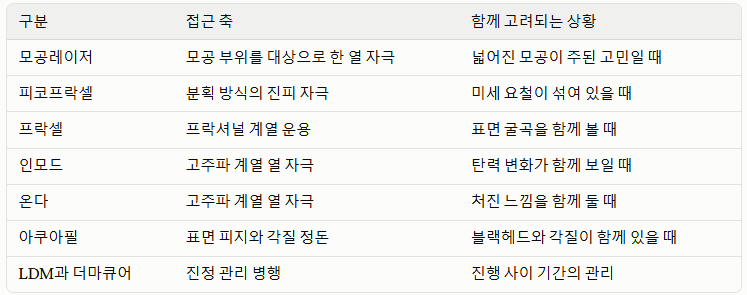
어느 조합이 적합한지는 피지량과 탄력 상태, 피부 두께에 따라 달라집니다.
한 가지로 고정하기보다 반응을 보며 조정해 가는 편입니다.
홍대 모공레이저 부작용과 미리 알아두실 점
👉 홍대 모공레이저는 열 자극을 동반하는 케어라 진행 후 진정 관리와 자외선 차단이 이후 경과에 크게 작용합니다.

모공이 사라지는 개념이 아니라는 점도 미리 알아두시면 좋습니다.
모공은 피지가 빠져나오는 통로라 없앨 수 있는 구조물이 아니며,
피지 분비 조건이 그대로라면 관리를 함께 이어가는 계획이 필요합니다.
⚠️ 홍대 모공레이저 시술 전후 주의사항
❓ 자주 묻는 질문 (FAQ)
Q. 세안을 열심히 해도 달라지지 않는데 홍대 모공레이저는 뭐가 다른가요?
A. 세안과 각질 관리는 모공 입구에 쌓인 피지와 각질을 정돈하는 접근입니다.
반면 모공 둘레를 받치는 진피 조직의 지지력이 떨어진 사정에는
닿지 않기 때문에, 진피에 열 자극을 주어 복구 과정을 작동시키는 방향으로 접근합니다.
Q. 홍대 모공레이저를 받으면 모공이 없어지나요?
A. 모공은 피지가 빠져나오는 통로라 없앨 수 있는 구조물이 아닙니다.
둘레를 안쪽에서 받쳐 덜 눈에 띄는 방향을 목표로
두고 계획하는 케어로 이해하시면 됩니다.
Q. 홍대 모공레이저는 왜 한 번에 강하게 하지 않나요?
A. 조직이 만들어지고 재배열되는 데에는 기간이 걸립니다.
회차마다 얇게 쌓아 가면 반응을 보며 강도와 간격을 조정하기 수월해서
이런 운용을 권해 드립니다.
Q. 블랙헤드가 많은데 홍대 모공레이저로 함께 볼 수 있나요?
A. 블랙헤드는 표면에 쌓인 피지가 산화된 형태에 가까워 접근 축이 다릅니다.
아쿠아필 같은 표면 정돈 관리를 함께 두고 계획하는 경우가 많습니다.
Q. 홍대 모공레이저 후 붉은 기는 왜 생기나요?
A. 진피에 남긴 열 자극에 피부가 복구 과정으로 반응하면서
첫 단계인 염증 반응이 일어나기 때문입니다.
회복이 진행되는 신호에 가깝고 대개 가라앉는 편입니다.
Q. 홍대 모공레이저는 회차 간격을 어떻게 잡나요?
A. 조직이 정돈되는 데 걸리는 기간이 사람마다 달라 일수를 단정하지 않습니다.
진행 후 피부가 어떻게 반응했는지 확인하며 다음 일정을 맞춰 가는 방식입니다.
홍대 모공레이저는 표면을 닦아 내는 접근으로는 닿지 않던 자리,
즉 모공 둘레를 받치는 진피 조직 쪽을 겨냥하는 케어입니다.
진피에 남긴 미세한 열 기둥에 피부가 복구 과정으로 반응하면서
새 아교질이 만들어지고, 그 조직이 모공 둘레를 안쪽에서
받치며 입구가 덜 벌어져 보이는 방향으로 바뀝니다.
한 번에 크게 바꾸는 방식이 아니라 회차마다 얇게 쌓아 가는 운용이라 부위별로
조건을 달리 잡기도 수월합니다.
클레오르의원 홍대점에서는 피지량과 탄력 상태, 모공이 넓어 보이는 부위를
함께 살펴 이 방향이 적합한지 상담 시 직접 확인해 드립니다.
미세한 요철이 함께 섞여 있으시다면 피코프락셀을 이어서 보기도 합니다.
거울을 가까이 볼 때마다 같은 자리가 신경 쓰이셨다면,
편하게 한 번 이야기 나눠보셔도 좋겠습니다.
※ 본 내용은 일반적인 정보 제공을 위한 글이며, 개인에 따라 나타나는 변화는 달라질 수 있습니다.
정확한 진단과 시술 여부는 전문의 상담을 통해 판단하시기 바랍니다.