

Hello.
I am Dr. Kim Dong-young, Director of Cleor Clinic Hongdae Branch.
There are moments when you feel something on your fingertips while applying eye cream.
It is a small, hard bump that is not easily visible to the eye but is clearly felt when touched.
Once it starts bothering you, you may find yourself pressing on that spot with your fingertips repeatedly.
Even if you try to squeeze it thinking it is a pimple, it does not come out easily,
and even after exfoliation, that spot remains exactly as it was.
I often hear patients say that their cotton pad catches on the same spot while removing makeup.
This means the lesion is located in a place that cannot be reached no matter how much you exfoliate the surface,
and there is a reason for this rooted in the very structure of the lesion.
Today, I will explain step by step what kind of lesion a milium is, why it does not come out when pressed,
and from which perspective the approach is taken.
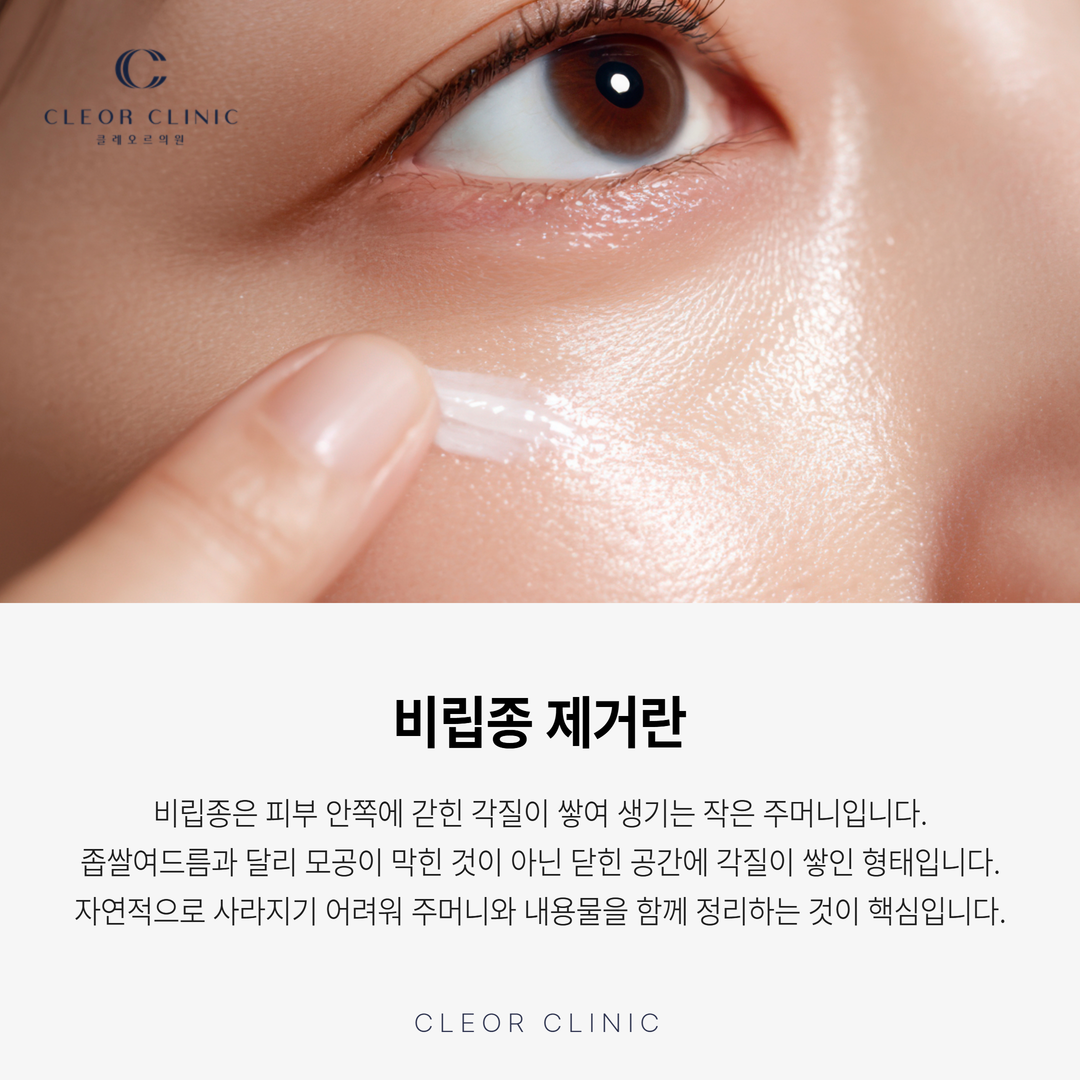
What is a Hongdae milium
👉 Hongdae milium care addresses benign lesions where keratin is trapped inside a very small sac under the skin, appearing as a white bump.
The key to understanding milia is the structure of this sac.
The wall of the sac is made of the same type of cells that form the epidermis,
and these cells continue to produce keratin inward.
The problem is that this sac is a closed form without an exit passage leading to the outside.
Since the produced keratin has no way to escape, it accumulates layer by layer inside,
and that mass becomes visible through the thin skin as a white or yellowish bump.This is why rubbing the surface or exfoliating does not reach it.
It is because it is not keratin sitting on the surface, but rather something enclosed by a wall inside the skin.
The reason it does not come out when pressed with your fingertips is the same.
Since there is no passage to push it out, no path is created even when pressure is applied.
A common point of confusion here is milia-like acne, or closed comedones.
Closed comedones are a state where sebum and keratin are clumped together inside a pore, blocking the entrance,
so it is a spot that originally had a passage.
Milia are different in nature because they are in the form of keratin trapped in a closed sac, separate from the pores.
The difference in whether it comes out when pressed also stems from this distinction.
At Cleor Clinic Hongdae Branch, when we see bumps around the eyes, we first determine whether it is
a milium, a closed comedone, or another type of lesion before deciding on the direction of care.
Strengths of Hongdae milium removal
👉 Hongdae milium care is not an approach of melting it away, but an approach of creating a path for it to come out.
First, we approach it in a way that suits its structure.
If there is a mass of keratin trapped inside and a wall blocking the passage,what is needed is not a procedure that covers a wide area.
It is about creating a very small opening at that specific point to provide a path for the contents to exit.
The actual approach follows this sequence.
We make a minimal hole on the surface and extract the keratin mass accumulated inside,
and since the target is clear, it is operated in a way that reduces the burden on the surrounding skin.
Second, we take an approach that also addresses the sac wall.
If you only extract the contents and leave the wall as it is, the cells forming that wall
may continue to produce keratin, leaving the possibility that the same spot will slowly fill up again.Therefore, we do not stop at extracting the contents but also address the sac wall.
This step reduces the possibility of it recurring in the same spot.
However, depending on skin conditions and constitution, new ones may form in other areas.
Third, we can adjust the conditions even for thin skin.
The area under the eyes and the eyelids are among the thinnest skin on the body,
so the size of the opening and the depth of contact must be kept to a minimum.
The method used here involves narrowing the irradiation range and precisely adjusting the depth.
This is based on the properties of the wavelength.
The 10,600nm wavelength produced by the CO2 laser is well absorbed by the moisture in the tissue.
Most of the energy is consumed at the layer it touches rather than penetrating deeply.
The ability to operate on a narrow range near the surface is based on this absorption property.
Therefore, we do not treat the forehead or cheeks and the area under the eyes with the same conditions, but adjust them separately.
Principle of milium removal
👉 Hongdae milium care creates a minimal exit in the closed sac and clears both the contents and the wall to stop the process of it filling up again.
First, we must look at why the closed state is maintained.

The cells of the sac wall have the same properties as epidermal cells, so they continue to produce keratin inward.
Since there is no passage leading to the outside, the produced keratin remains inside,
and as time passes, the volume increases little by little until it can be felt on the surface.It is a form that is difficult to disappear on its own.Next is the step of creating a path.
When a very small opening is made on the surface, an exit that did not exist before is created,
and the keratin mass that was pressed inside can be extracted.
It is a principle to keep this opening to the minimum according to the size of the lesion,
so the area being treated is kept very narrow.
The last step is organizing the wall.Even after the contents are extracted, if the wall that was producing keratin
remains, the same process can start again.
Therefore, we approach it by addressing the wall as well to stop that process.
It is common for a very small scab to form where the path was created,
and since how you pass this period determines the subsequent surface condition, care instructions are provided.
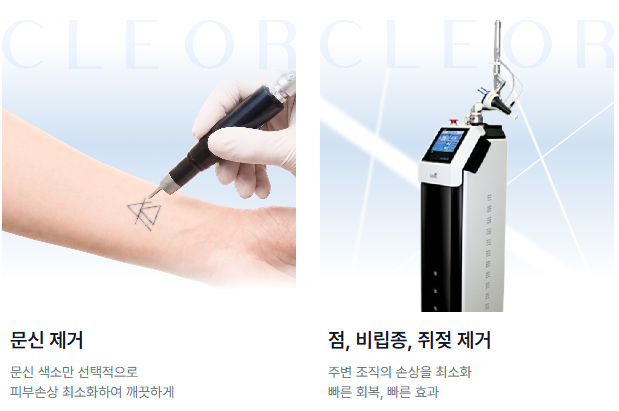
Equipment and programs for Hongdae milium👉 The equipment used for milium care is a CO2 laser for mole removal,
and at Cleor Clinic Hongdae Branch, we divide the procedure units based on the location and number of the bumps.
Milia are in a state where keratin is trapped inside a closed sac.
This is why they do not come out when squeezed, and a process of opening the surface covering the sac very slightly is necessary.
The CO2 laser sets the diameter of the opening in millimeter units.
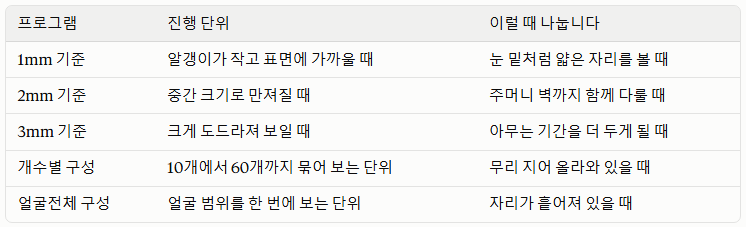
The configuration divided into 1mm, 2mm, and 3mm is based on that diameter,
and in thin areas like under the eyes or eyelids, we lower the output and set a shallower depth.
The reason we divide the areas and schedule sessions when there are many is to avoid opening a large area at once.
Even if they look similar to closed comedones on the surface, the structure of their formation is different,
so there are cases where it is difficult to determine their nature by the naked eye alone.
The unit of the procedure is decided after first identifying the nature during the consultation.
Who needs Hongdae milium removal
Those who are bothered by white bumps under their eyes every time they apply eye cream
Those who have just left them alone because nothing came out when they tried to press them
Those whose bumps remained in the same place even after receiving exfoliation care
Those who are confused about whether it is a closed comedone or a milium and want to get it checked first
Those who were cautious about touching it because it is a thin area like the eyelid
Types of skin lesion removal in Hongdae
👉 Small lesions that rise above the skin have different structures of formation, so we determine the approach after first identifying their nature.
The items we examine at Cleor Clinic Hongdae Branch are summarized below.
There are cases where it is difficult to determine the nature by the naked eye alone, so we identify it first during the consultation before deciding on the direction.
Side effects and things to know in advance about Hongdae milium
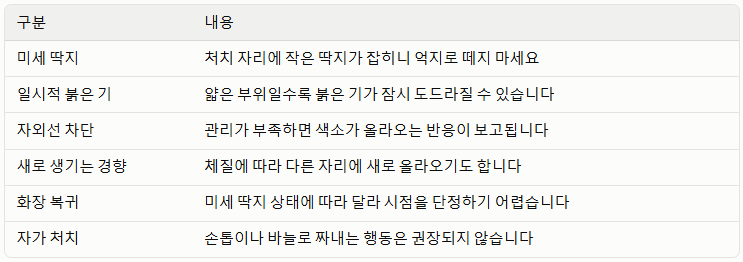
👉 Hongdae milium care is a procedure that creates a small path on the surface, so care for the following few days is required.
Because of their nature of being trapped in a sac form, they rarely come out when pressed,
and if handled with unsterilized tools, there is a possibility of inflammation or scarring.
While it is difficult to conclude that eye cream or products with high oil content cause milia,
the habit of using eye products is an item we examine together during the consultation.
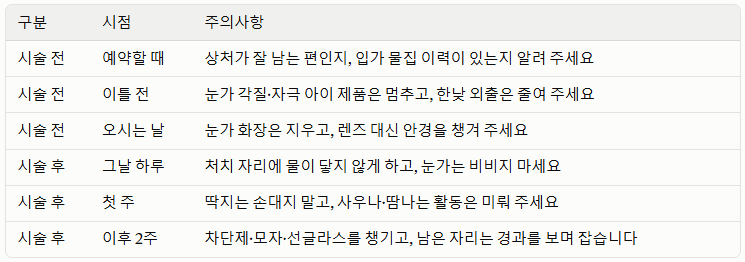
⚠️ Precautions before and after Hongdae milium procedure

❓ Frequently Asked Questions (FAQ)
Q. Why don't Hongdae milia come out when squeezed?
A. It is because the keratin is trapped inside a closed sac,
and that sac has no passage leading to the outside.
There is no path to push it out, so it does not come out even when pressure is applied,
and if handled forcibly, there is a possibility of inflammation or scarring.
Q. How do you distinguish between a Hongdae milium and a closed comedone?
A. A closed comedone is a case where a pore that originally had a passage is blocked by sebum and keratin,
while a milium is a case where keratin is trapped surrounded by a wall, regardless of the pore.
Because the structure of their formation is different, the method of handling them also differs, so we distinguish them first during the consultation.
Q. Can Hongdae milia be removed by exfoliation?
A. They are not keratin sitting on the surface, but are placed inside the skin surrounded by a wall,
so methods that clean the surface do not reach them.
This is why an approach that creates a path for the internal contents to exit is necessary.
Q. Do Hongdae milia come back in the spot where they were removed?
A. If the wall that was producing the keratin is also addressed,
it is reported that the possibility of that spot filling up again is reduced.
However, depending on skin conditions and constitution, new ones may form in other areas.
Q. Is Hongdae milium care possible for thin areas like under the eyes?
A. We operate by keeping the size of the opening and the depth of contact to a minimum.
By using the properties of the wavelength that is absorbed by the moisture in the tissue,
it is easy to treat only a narrow range near the surface.
Therefore, we adjust the conditions differently from the forehead or cheeks.
Q. When can I wear makeup after milium care?
A. It depends on the state of the micro-scab, so we do not specify a number of days.
We tend to provide guidance based on the condition of the day while observing the process of the scab passing naturally.
Milia are not a concept of rubbing the surface to remove them.
It is closer to a process of creating a very small path in a sac that was closed without a passage,
and extracting the keratin trapped inside.
As the reason they did not come out when pressed and could not be reached by exfoliation lay in their structure,
the approach is also set according to that structure.
Not stopping at extracting the contents but also addressing the sac wall, and keeping the opening and depth to a minimum in thin areas like under the eyes are the pillars of this care.
At Cleor Clinic Hongdae Branch, we check the location, depth, and number of the bumps together and confirm directly during the consultation whether this direction is correct.
When seeing things with different natures like moles or skin tags on the same day, we may also separate the order of the procedures.
If you have always felt the same bumps on your fingertips, please feel free to stop by and have a conversation.
※ This content is for general information purposes only, and changes may vary depending on the individual.
Please determine the exact diagnosis and whether to proceed with the procedure through consultation with a specialist.
눌러도 나오지 않고 각질 제거로도 닿지 않던 이유가 구조에 있었던 만큼,
접근도 그 구조에 맞춰 잡게 됩니다.
내용물을 꺼내는 데서 멈추지 않고 주머니 벽까지 함께 보는 점,
눈 밑처럼 얇은 자리에서 개구부와 깊이를 최소로 잡는 점이 이 케어의 축입니다.
클레오르의원 홍대점에서는 알갱이가 놓인 자리와 깊이,
개수를 함께 보고 이 방향이 맞는지 상담 시 직접 확인해 드립니다.
점이나 쥐젖처럼 성격이 다른 것들을 같은 날 보실 때는 순서를 갈라 잡기도 합니다.
손끝에 늘 같은 알갱이가 걸리셨다면 가볍게 들러 이야기 나눠 보셔도 좋겠습니다.
※ 본 내용은 일반적인 정보 제공을 위한 글이며, 개인에 따라 나타나는 변화는 달라질 수 있습니다.
정확한 진단과 시술 여부는 전문의 상담을 통해 판단하시기 바랍니다.