

Hello.
I am Dr. Kim Dong-young, Director of Cleor Clinic Hongdae Branch.
Have you ever paused while applying sunscreen to your neck?
We pay attention to our faces every day, but we rarely look closely at our necks until one day, we suddenly notice something has changed.
I often hear people say they feel something catching on their necklace chain.
Many also mention that while there were only one or two at first, they realized the number had increased significantly at some point.
Skin tags, medically known as acrochordon, are benign skin lesions that are known to occur frequently in areas with high friction, such as the neck, around the eyes, or the armpits.
Today, I will explain step-by-step why skin tag removal in Hongdae requires a different approach than treating pigmentation, why certain wavelengths are used for this tissue, and how we categorize the process based on the area and number of lesions.
What is Hongdae skin tag removal?
👉 Hongdae skin tag removal is a procedure that gently removes the raised acrochordon tissue layer by layer from the skin surface.
Understanding the structure of a skin tag makes it easier to understand why the approach differs.
A skin tag is not a lesion caused by a collection of pigment.

It is a tissue that rises above the surface, with a core made of dermal collagen fibers and small blood vessels, covered by the epidermis.
It feels slightly loose and can be skin-colored or a bit darker, and its size varies from the size of a grain of rice to more prominent growths.
This is where the approach differs.
For flat pigmented spots, we can use light to break down the pigment particles so the body can process them.
However, a skin tag is not pigment; it is the tissue itself that is raised.
It cannot be treated with lasers that target pigment; the tissue must be physically removed.
This is also where it differs from mole removal.
Since a mole is a lesion where pigment cells are clustered, the approach depends on the depth.
For skin tags, since the core tissue is dermal collagen, the focus is on how to remove the part that rises above the surface.
This is why we distinguish their nature during the consultation, even if they look similar on the surface.
Skin tag removal: A method of removing only the raised portion
👉 We can use a wavelength that is strongly absorbed by water to gently remove only the raised portion.
First, the approach of treating the tissue itself.
The method of dispersing pigment is for pigmented lesions and does not apply to raised tissue.
This procedure is planned from the start to remove the tissue, so the nature of the lesion and the approach are aligned.
Instead, we consider identifying the nature of the lesion first.
Since the treatment method varies depending on whether it is a skin tag, milia, or a mole, we distinguish them during the consultation.
Second, the wavelength characteristics of the CO2 laser allow for depth control.
The 10,600nm light emitted by a CO2 laser is very strongly absorbed by water.
Since human tissue is mostly water, this light consumes its energy in the shallow layer where it touches, vaporizing the moisture in that spot.
Because it does not penetrate deep into the layers and the heat spreading to the surrounding area is limited, we can remove only the raised tissue in very thin layers while visually monitoring how much to remove.This also means it is an approach that does not require treating the surrounding flat skin.
Third, it can be performed by dividing the area and number of lesions.
The skin on the neck is relatively flexible, while the skin around the eyes is thin.
Even for lesions of the same size, the depth setting for removal is adjusted based on the location, and this adjustment is possible because we treat each spot individually.
When there are many lesions and the area is large, we may divide the treatment into sessions.
This decision takes into account the healing period of the scabs and your daily schedule.
The principle of skin tag removal
👉 We use the property that light absorbed by water consumes energy at that specific spot to control the depth.Light is absorbed by different targets depending on the wavelength.
Just as lasers targeting pigment use wavelengths well-absorbed by melanin, the 10,600nm of a CO2 laser has very high absorption in water.
The moment it touches the tissue, most of the energy is used in the layer near the surface, reducing the amount that travels deeper.
The absorbed energy instantly heats and vaporizes the moisture in that spot.
This is the process by which the raised tissue is removed layer by layer, and because the energy is consumed in the shallow layer, the heat spreading to the sides is also limited.
This is why we can stop at the point where it becomes level with the surface by lowering it little by little to the desired height.
Next is the healing period.
A thin scab forms where the tissue was removed, and the process of the epidermis covering it again follows.
How you use ointments and regenerative tapes during this period, and how you block UV rays, greatly influences any marks left behind.This is why I say that half of the care is the aftercare.
Equipment and programs
👉 Skin tag removal at Cleor Clinic Hongdae Branch is performed using a CO2 laser for mole removal, and the configuration is divided based on how many to treat at once.
The CO2 laser emits light in the 10,600nm band.
This wavelength is very well absorbed by water, and since skin tissue is mostly water, heat is created immediately where the light touches.
It is a method of gently removing only the raised tissue with that heat.
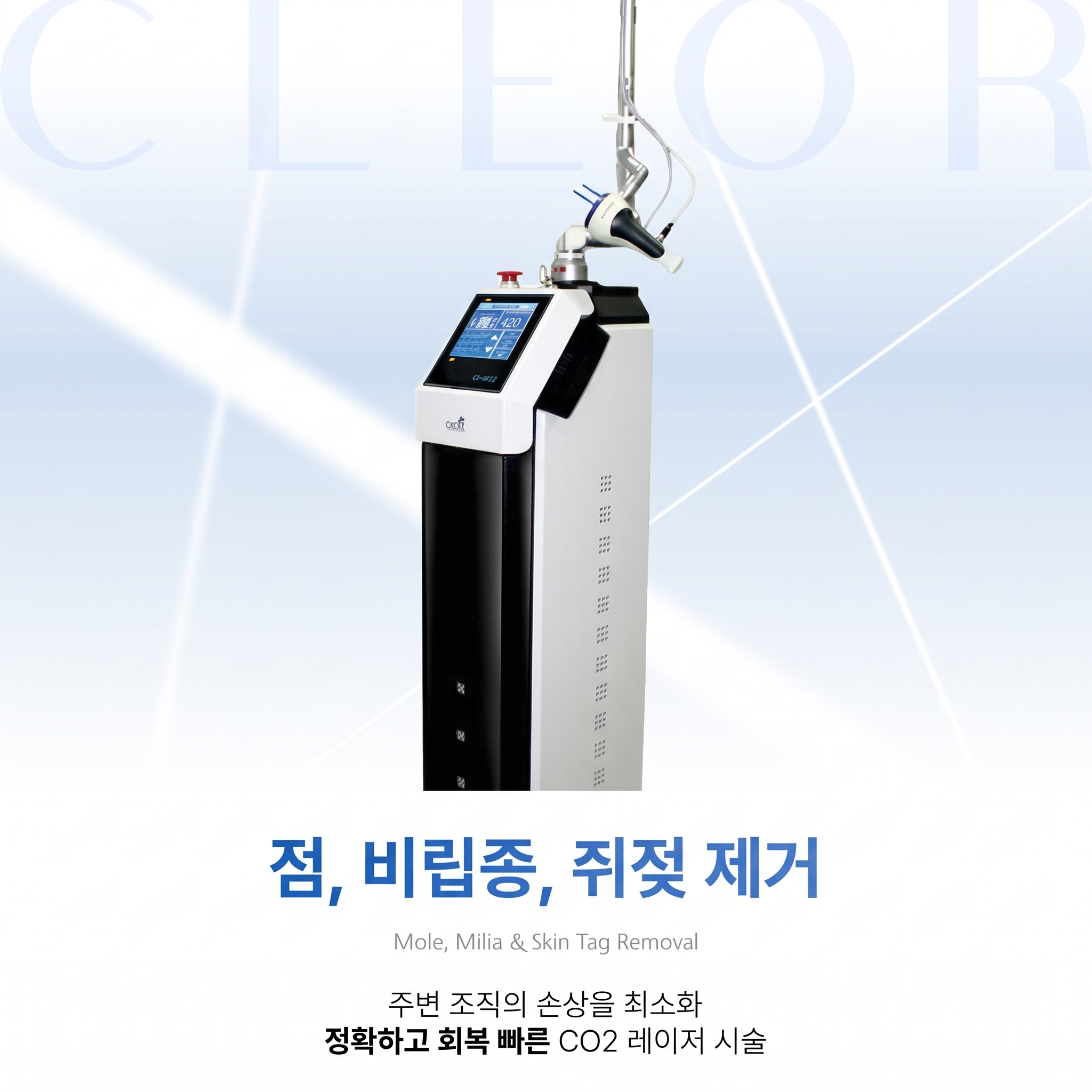
The fact that the range of heat exposure is narrow is important in this equipment configuration.
The heat is consumed at the target site, minimizing the amount that spreads to the sides, and because the depth can be adjusted layer by layer, it can also be used on thin areas like the neck.
Even with the same equipment, the healing period and aftercare vary depending on how the output and depth are set.
How many to treat at once is determined after counting the lesions in person during the consultation.
You may need this if:
You have bumpy growths around your neck that keep catching on necklaces or clothes.
You see small, loose lesions in areas with frequent friction, such as around the eyes or armpits.
You have many lesions and need to decide whether to treat them all at once or in sessions.
You have received pigment laser treatment, but the raised lesions remained.
You want to have them examined through a consultation rather than touching them yourself at home.
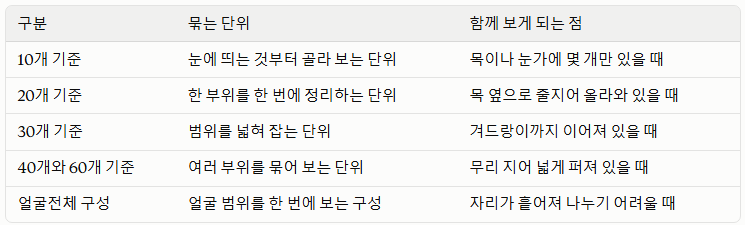
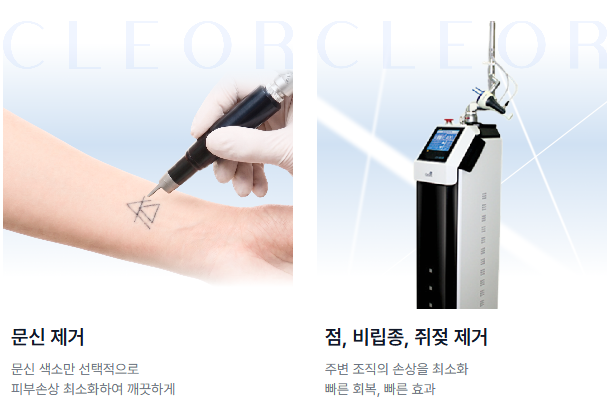
Types of skin lesion removal in Hongdae
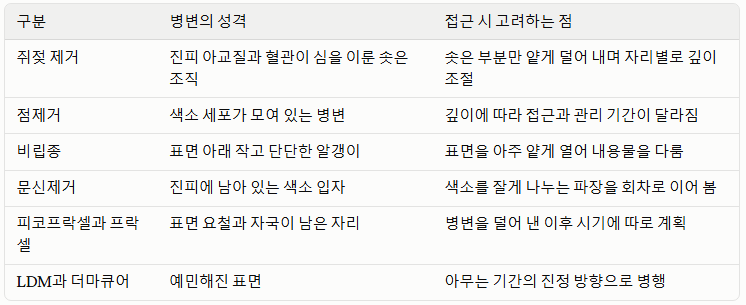
👉 The method of treating lesions on the skin depends on their nature.
The items operated at Cleor Clinic Hongdae Branch, organized by the nature of the lesion, are as follows.
Which approach is appropriate depends on the nature, location, and size of the lesion, so we distinguish them first during the consultation before setting a direction.
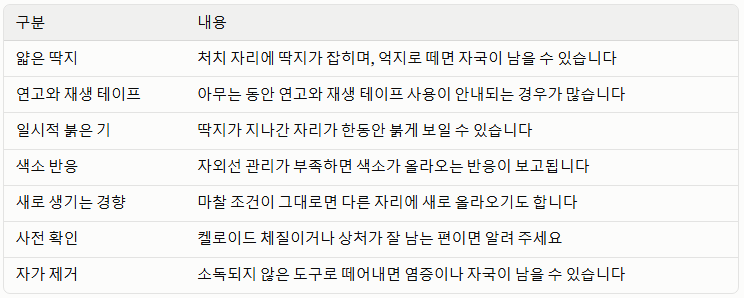
Possible reactions and things to keep in mind
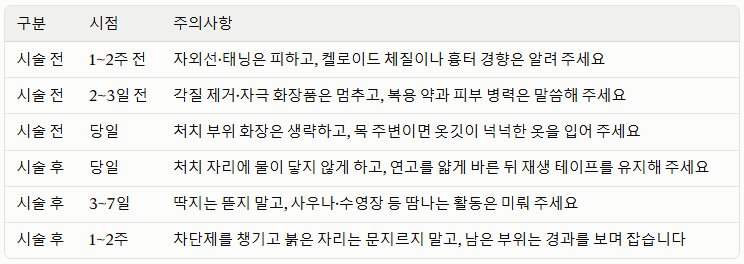
👉 As this is a procedure that physically removes tissue, aftercare during the healing period is required.
⚠️ Precautions before and after the procedure
❓ Frequently Asked Questions (FAQ)
Q. Is it possible with a pigment laser?
A. A skin tag is not a pigmented lesion; it is a tissue that rises above the surface with a core of dermal collagen and blood vessels. It cannot be treated with wavelengths that target pigment, so we plan an approach that removes the tissue itself.
Q. Why use a CO2 laser?
A. The 10,600nm light emitted by a CO2 laser is very strongly absorbed by water. Since most of the tissue is water, the energy is consumed immediately in the shallow layer it touches, and the heat spreading to the surroundings is limited. Therefore, we can adjust the depth by removing only the raised part in thin layers.
Q. Is it possible for thin areas like around the eyes?
A. For thin areas, we set the removal depth more precisely. Since we treat each spot individually, we can set different conditions depending on the location, and we determine feasibility and direction after examining the condition of the lesion.
Q. I have many, can they all be treated at once?
A. If the area is large, we may suggest dividing the treatment into sessions. We make this decision by considering the healing period of the scabs and your daily schedule.
Q. I am worried about marks after the procedure.
A. There are cases where redness is visible for a while where the scabs were, and subsequent UV protection and not touching the scabs greatly influence the progress. It is known that consistent use of sunscreen is helpful.
Q. Is the approach for removing moles or milia the same as for skin tags?
A. Even if they look similar on the surface, the nature of the lesions is different. A mole is a lesion where pigment cells are clustered, and a milia is a lesion where a grain is felt under the surface, so we distinguish them first during the consultation before making a plan.
Hongdae skin tag removal is not a concept of treating the skin over a wide area.
It is a process of gently removing only the raised tissue and helping the area heal well.
Since it is a tissue lesion, not a pigment one, an approach using lasers that target pigment does not work, and by using a 10,600nm wavelength that is strongly absorbed by water, the energy is consumed in the shallow layer, allowing us to control it while watching the depth.
Since we set different depth settings depending on the location and size, and may divide the procedure if there are many, we will check which direction is appropriate for you during the consultation.
Cleor Clinic Hongdae Branch operates lesion removal items including mole removal and milia treatment.
If you have been bothered every time you put on a necklace, please feel free to come in and talk to us.
※ This content is for general information purposes only, and changes may vary from person to person.
Please consult with a specialist to determine the exact diagnosis and whether the procedure is suitable for you.
어떤 접근이 적합한지는 병변의 성격과 자리,
크기에 따라 달라지므로 진료에서 먼저 구분한 뒤 방향을 잡습니다.
나타날 수 있는 반응과 알아두실 점
👉 조직을 직접 덜어 내는 케어라 아무는 기간의 관리가 함께 따라옵니다.
⚠️ 진행 전후 주의사항
❓ 자주 묻는 질문 (FAQ)
Q. 색소 레이저로도 가능한가요?
A. 쥐젖은 색소 병변이 아니라 진피의 아교질과 혈관이
심을 이루고 표면 위로 솟아오른 조직입니다.
색소를 겨냥하는 파장으로는 다룰 수 없어 조직 자체를 덜어 내는 접근으로 계획을 잡습니다.
Q. 왜 탄산가스 레이저를 쓰나요?
A. 탄산가스 레이저가 내는 10,600nm 빛은 물에 매우 강하게 흡수됩니다.
조직의 대부분이 물이라 에너지가 닿은 얕은 층에서 바로 소모되고,
주변으로 퍼지는 열도 제한됩니다.
그래서 솟아오른 부분만 층층이 얇게 덜어 내며 깊이를 조절할 수 있습니다.
Q. 눈가처럼 얇은 부위도 가능한가요?
A. 얇은 자리는 덜어 내는 깊이 설정을 더 세밀하게 잡습니다.
한 자리씩 개별로 다루는 방식이라 자리에 따라 조건을 달리 잡을 수 있으며,
가능 여부와 방향은 병변 상태를 보고 판단합니다.
Q. 개수가 많은데 한 번에 다 볼 수 있나요?
A. 범위가 넓으면 부위를 나누어 회차를 두는 방향이 안내되는 경우가 있습니다.
딱지가 아무는 기간과 일상 일정을 같이 감안해 판단하게 됩니다.
Q. 시술 후 자국이 남을까 걱정됩니다.
A. 딱지가 지나간 자리에 붉은 기가 한동안 보이는 경우가 있고,
이후 자외선 관리와 딱지를 건드리지 않는 쪽이 경과를 크게 좌우합니다.
차단제를 꾸준히 쓰시는 편이 도움이 된다고 알려져 있습니다.
Q. 점이나 비립종과 쥐젖 제거는 접근이 같나요?
A. 겉보기로는 비슷해 보여도 병변의 성격이 다릅니다.
점은 색소 세포가 모인 병변이고 비립종은 표면 아래 알갱이가 잡히는 병변이라,
진료에서 먼저 구분한 뒤 계획을 잡습니다.
홍대 쥐젖 제거는 피부를 넓게 다루는 개념이 아닙니다.
솟아 있는 조직만 얕게 덜어 내고 그 자리를 잘 아물게 하는 과정입니다.
색소가 아닌 조직 병변이라 색소를 겨냥하는 레이저로는 접근이 성립하지 않고,
물에 강하게 흡수되는 10,600nm 파장을 쓰면 에너지가 얕은 층에서
소모되어 깊이를 보며 조절할 수 있습니다.
자리와 크기에 따라 깊이 설정을 달리 잡고 개수가 많으면 나누어 진행하기도 하므로,
어느 방향이 적합한지는 상담 시 직접 확인해 드립니다.
클레오르의원 홍대점에서는 점제거와 비립종을 포함한
병변 제거 항목을 함께 운영하고 있습니다.
목걸이를 채울 때마다 신경 쓰이셨다면, 편하게 한 번 이야기 나눠 보셔도 좋겠습니다.
※ 본 내용은 일반적인 정보 제공을 위한 글이며, 개인에 따라 나타나는 변화는 달라질 수 있습니다.
정확한 진단과 시술 여부는 전문의 상담을 통해 판단하시기 바랍니다.