
Hello.
I am Dr. Kim Dong-young, Director of Cleor Clinic Hongdae Branch.
Have you ever felt that your enlarged pores are more noticeable under lighting when taking selfies, or that acne scars are difficult to cover with makeup because the skin texture is uneven?
"My pores are getting larger, and old acne scars remain.
I've looked into Fraxel and Potenza, but I'm confused about which one is right for me, and I'm curious about how the principles of the two procedures differ."
This is a category of inquiry we receive frequently.
Since enlarged pores and acne scars are difficult to address with surface care alone, they require procedures that deliver stimulation directly to the dermis.
There are two main approaches:
Pico Fraxel, which reaches the dermis using a laser method, and
Potenza, which stimulates the dermis with microneedles, are the representative categories that have established themselves in this field.
Hongdae pore and scar treatment involves utilizing these two devices according to your skin condition and goals.
Today, I will explain how the Pico Fraxel MLA and DOE methods differ,
what the differences are from Potenza, and which combinations are suitable.
What is Hongdae pore and scar treatment?
👉 For Hongdae pore and scar treatment, two devices are used according to skin condition and goals: Pico Fraxel, which reaches the dermis using the fractional lens method of a picosecond laser, and
Potenza, which delivers RF energy to the dermis through microneedles.

Enlarged pores and acne scars are usually caused by collagen damage in the dermis, not the epidermis.
Because this category is difficult to address with epidermal care or cosmetics alone,
it is a line that requires procedures capable of delivering direct stimulation to the dermis.
Pico Fraxel, which reaches the dermis via laser,
has the characteristic of inducing collagen stimulation while minimizing epidermal irritation,
and Potenza, which combines microneedles with RF energy, allows the needles to penetrate the dermis directly to
deliver stimulation and absorb skin boosters simultaneously.
Although both devices share the commonality of reaching the dermis, their approaches differ,
so it is known as a category where suitable options vary depending on skin condition, pore patterns, and scar types.
How Pico Fraxel laser works
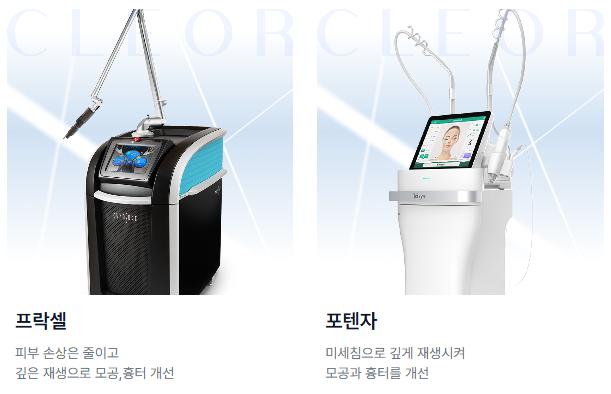
👉 Pico Fraxel is a method that passes a high-speed picosecond laser through a fractional microlens to
precisely deliver energy only to the dermis, thereby inducing collagen regeneration while minimizing epidermal irritation.
Picosecond laser
A picosecond is a very short unit of time, representing one trillionth of a second.
Because laser energy is irradiated within this short time, it is a category characterized by being concentrated only on the target area with almost no time for heat to spread to surrounding tissues.
Fractional lens method
Pico Fraxel is a method that passes a single laser through a special lens to divide it into very small dots.
Since less than 10% of the skin surface is exposed to high-intensity energy and the remaining area is maintained at low density,
it is known to deliver precise stimulation only to the target point without damaging the entire epidermis.
Dermal collagen stimulation
When laser energy reaches the dermis, a micro-cavitation reaction occurs, activating collagen regeneration signals.
As collagen is continuously produced over 3 to 6 months after the procedure,
this category proceeds in a direction where pores are tightened and scar irregularities are smoothed out.
Simultaneous approach to pigmented lesions
Pico Fraxel has the characteristic of being able to address pigmented lesions as well.
It is an option line that can be managed together if there is pigmentation or blemishes along with acne scars.
Difference between MLA and DOE methods
👉 The Pico Fraxel at our Hongdae branch is configured to allow you to choose between two options according to your skin condition: the MLA method, which offers gentle stimulation and short downtime, and
the DOE method, which focuses on scar improvement with stronger stimulation.
MLA method
MLA stands for Micro Lens Array, a method where thousands of micro-lenses are arranged.
Because the laser is gently divided into dots and the stimulation is relatively weak,
it is a line with short downtime and minimal redness and swelling.
It is a category known to be suitable for enlarged pores, fine lines, and early acne scars.
DOE method
DOE stands for Diffractive Optical Element,
which is an option that divides the laser in a different way than MLA.
Because the stimulation is stronger than MLA, redness and
minute dot-like marks may appear immediately after the procedure, but it is a line that focuses on deep scar improvement.
It is a method considered when deep, old acne scars or uneven skin texture with distinct curves need to be smoothed out.
Choosing according to skin condition
Even with the same Pico Fraxel, the suitable method varies depending on skin thickness, scar depth, and downtime availability,
so the direction between MLA and DOE is determined after a pre-procedure consultation.
Difference from Potenza
👉 Pico Fraxel is a non-invasive method that reaches the dermis with laser energy, while Potenza is an invasive method that directly stimulates the dermis with microneedles and
delivers RF energy, so the principles of approach and usage purposes are different.
Approach method - Laser vs. Microneedle
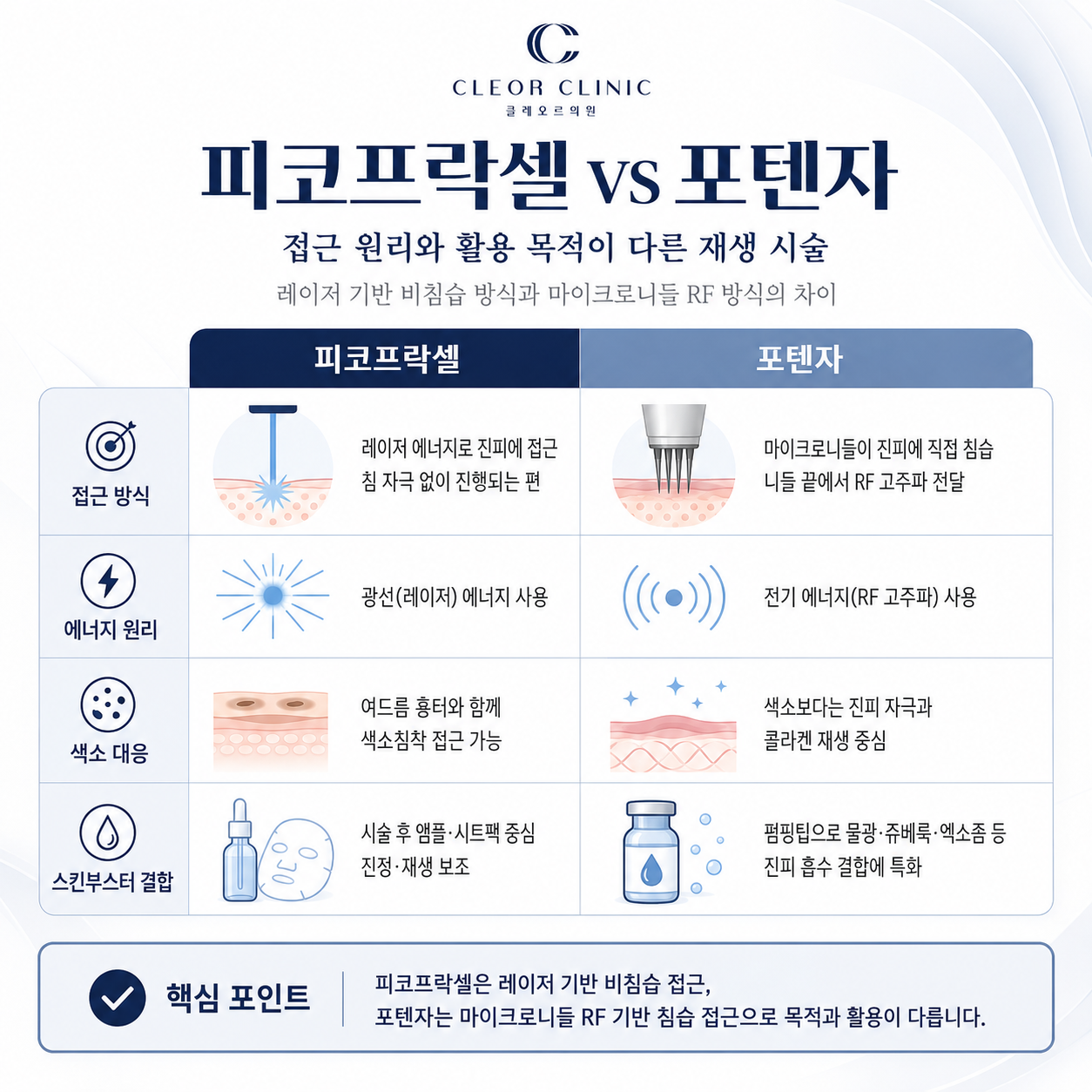
Pico Fraxel reaches the dermis with laser energy, so it proceeds without needle stimulation.
Potenza is a category where physical stimulation occurs simultaneously because thin microneedles actually penetrate the dermis
and deliver RF energy from the needle tips.
Energy principle - Light vs. RF energy
Pico Fraxel uses light energy (laser), and Potenza uses electrical energy (RF).
Because the two energy principles are different, the nature of the stimulation and tissue response appear differently.
Pigmentation response - Possible vs. Limited
Pico Fraxel is an option that can address acne scars along with pigmentation.
Potenza focuses more on dermal stimulation and collagen regeneration rather than pigmentation,
so if pigmentation is present, combination with other procedures is often considered.
Skin booster combination - Limited vs. Specialized
Potenza has a specialized function through the pumping tip option that allows
skin boosters like water glow, Juvelook, or exosomes to be absorbed directly into the dermis.
Pico Fraxel is a method that aids soothing and regeneration with ampoules or sheet masks after the procedure,
so Potenza is known as a category with high utility for skin booster combination options.
Hongdae pore and scar treatment lineup
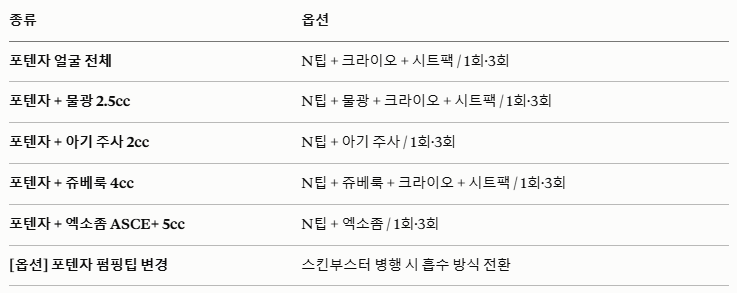
👉 At the Hongdae branch, we operate Pico Fraxel and Potenza as partial or full-face options and skin booster combination options, and the configuration includes post-procedure soothing care.
Pico Fraxel line
Potenza line
Since combining the two devices or proceeding at different times is also considered,
we will look at the combination suitable for your skin condition during the pre-procedure consultation.
Who is Hongdae pore and scar treatment suitable for?

Those whose enlarged pores are noticeable under lighting
Those concerned about scars and uneven texture left by past acne
Those who feel a decline in skin texture that cannot be improved by surface care
Those who have both acne scars and pigmentation
Those looking for combination options because they want to include skin booster absorption
Side effects and things to know in advance about Hongdae pore and scar treatment
👉 Although Hongdae pore and scar treatment is a line composed of devices with long-standing clinical data,
it is good to understand in advance that recovery speed and result stability vary depending on skin condition and the choice of procedure method.
Immediately after the procedure,
mild redness, slight swelling, heat, and
thin scabs or embossing marks may appear depending on the method.
It is generally reported to resolve naturally within a few hours to a maximum of 1 week.
After Pico Fraxel DOE or Potenza procedures,
marks may remain for a few days, so it is better to
coordinate the timing of the procedure before important schedules.
Pore and scar improvement is a flow that gradually settles
as collagen regeneration accumulates over 3 to 6 months after the procedure.
It is known as a category where stable results are reported when repeated
3 or more times at 3-4 week intervals rather than expecting a big change from a single session.
If UV protection is insufficient after the procedure, there is a possibility of pigmentation,
so UV protection is a line important for recovery stability.
Stability is secured by checking your skin condition and
scar type during a pre-procedure consultation according to the guidance of experienced medical staff.
If any of the following apply, the procedure may be restricted or
pre-confirmation may be required, so please inform us during the consultation.
If you are pregnant or breastfeeding
If there is active herpes, infection, or severe acne inflammation in the treatment area
If you have been diagnosed with an autoimmune disease or keloid tendency
If you are taking photosensitive medication or have a recent history of strong peeling or laser procedures
If you have metal implants such as a pacemaker (related to Potenza)
If you have recently tanned or the treatment area is deeply tanned
⚠️ Precautions before and after Hongdae pore and scar treatment
👉 Hongdae pore and scar treatment is a procedure where recovery speed and collagen response stability vary depending on pre-procedure UV and irritation management and post-procedure soothing and moisturizing care.
❓ Frequently Asked Questions (FAQ)
Q. Should I choose Fraxel or Potenza for Hongdae pore and scar treatment?
It depends on your skin condition and goals.
If you have pigmentation or want a short downtime, Pico Fraxel is suitable, and if you want to include absorption through skin booster combination,
Potenza is a suitable category, so we will organize this during the pre-procedure consultation.

Q. How do I choose between Pico Fraxel MLA and DOE methods?
It depends on downtime availability and scar depth.
If you want gentle stimulation and short downtime, MLA is considered, and if you want an approach focused on deep scars, the DOE method is considered,
so it is decided after checking your skin condition during the pre-procedure consultation.
Q. When can I see the results of Hongdae pore and scar treatment?
You can feel subtle changes in skin texture immediately after the procedure.
Full-scale collagen response settles from 3 to 4 weeks after the procedure
and is reported to continue to improve over 3 to 6 months.
Q. How many sessions of Hongdae pore and scar treatment should I receive?
Stable results are reported when repeated 3 or more times at 3-4 week intervals.
It is a category where the number of sessions may extend to 5 or more if pores are large or scars are deep, so we will organize the number of sessions during the pre-procedure consultation.
Q. Can I proceed with Fraxel and Potenza together?
Combining the two devices or proceeding at different times is also considered.
It is a category where alternating methods with intervals between sessions are often used rather than doing them in the same session,
so we will organize a plan suitable for your skin condition during the pre-procedure consultation.
Q. How much pain is involved in Hongdae pore and scar treatment?
Since it is a method performed after applying anesthetic cream before the procedure, strong pain is not significant.
You may feel a brief stinging and heat during the procedure, and the intensity of stimulation varies depending on the method and
device, so Pico Fraxel DOE or
Potenza tends to provide relatively stronger stimulation.
Q. When can I wear makeup after Hongdae pore and scar treatment?
Light makeup is possible from the next day for the MLA method,
but for the DOE method or Potenza, marks may remain for a few days after the procedure,
so it is a category where it is good for recovery stability to start with mild products after 3 to 5 days.
Enlarged pores and acne scars are caused by collagen damage in the dermis, not the epidermis,
so it is a category where fundamental approach is difficult with surface care alone.
This is why procedures that can deliver direct stimulation to the dermis are necessary.
For Hongdae pore and scar treatment, Pico Fraxel, which reaches the dermis
using the fractional lens method of a picosecond laser, and Potenza, which directly stimulates the dermis with microneedles and
delivers RF energy, are used according to skin condition and goals.
At the Hongdae branch, we also operate various skin care lines in addition to pore and scar management.
Skin booster lines focused on skin regeneration and texture smoothing,
lifting lines that approach elasticity management,
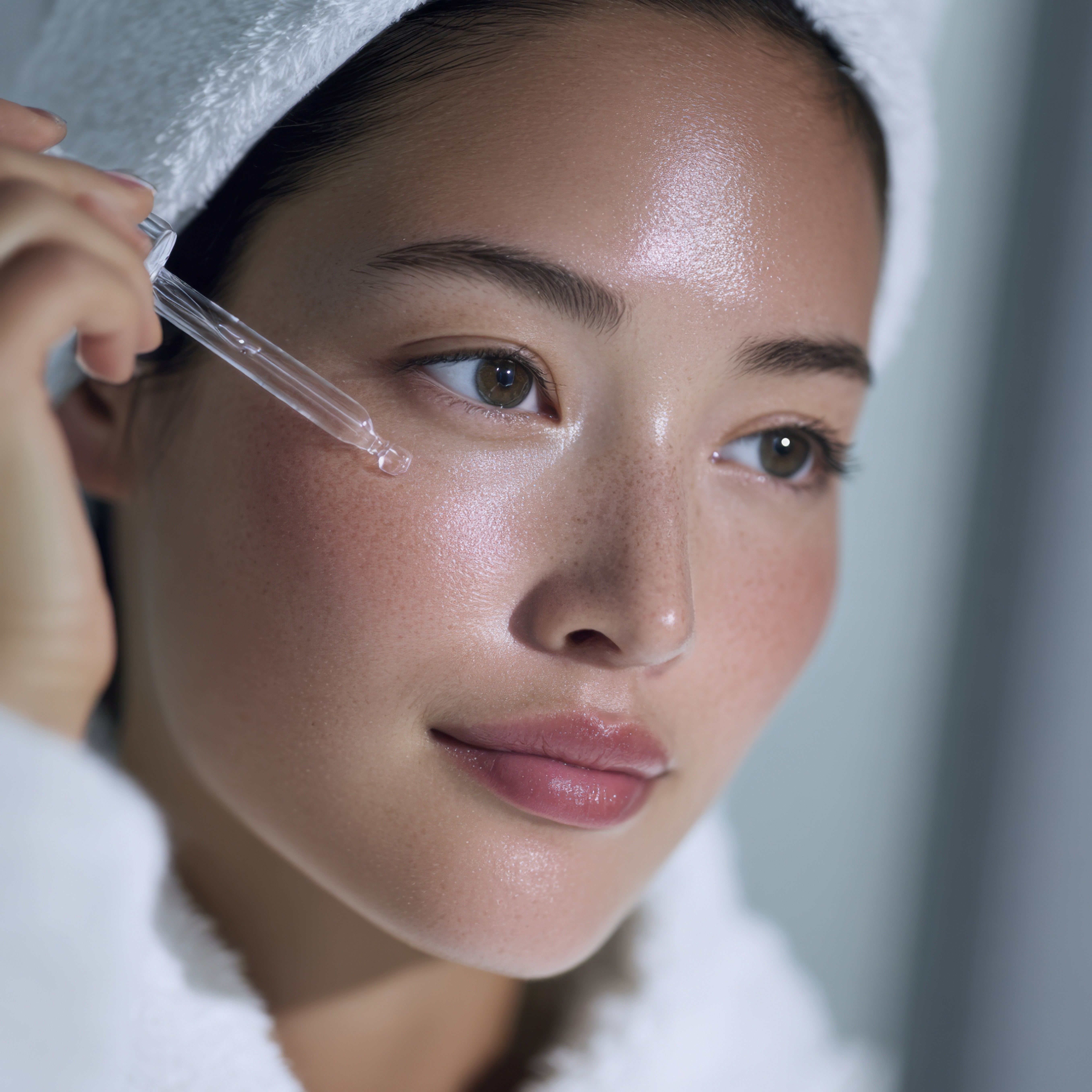
and toning lines considered when pigmentation and tone correction are needed,
are categories you can consider together depending on the area and purpose.
We will check the direction suitable for your pore and scar condition
directly during the consultation.
If you are concerned about enlarged pores and old acne scars,
please feel free to visit Cleor Clinic Hongdae Branch.
Even before deciding on a procedure, you can check the current state of your skin
through a pre-procedure consultation.
※ This content is for general information purposes only, and results may vary by individual.
Please decide on accurate diagnosis and procedure through consultation with a specialist.
부위와 목적에 따라 함께 검토하실 수 있는 카테고리입니다.
본인 모공과 흉터 상태에 어울리는 방향은
상담 시 직접 확인해 드립니다.
넓어진 모공과 지나간 여드름 자국이 신경 쓰이신다면
클레오르의원 홍대점으로 부담 없이 방문해 주세요.
시술 결정 전이라도 사전 진료를 통해
본인 피부의 지금 상태를 함께 살펴보실 수 있습니다.
※ 본 내용은 일반적인 정보 제공을 위한 글이며, 개인에 따라 결과는 달라질 수 있습니다.
정확한 진단과 시술 여부는 전문의 상담을 통해 결정하시기 바랍니다.