

Hello!
I am Director Dong-young Kim of Cleor Clinic Hongdae Branch.
"Every time I look in the mirror, my skin looks dull and dry, so I lose confidence."
"My foundation keeps flaking because of dead skin cells. It feels like nothing I apply works."
"Even with thorough cleansing, my skin texture remains uneven."
Skin texture and dead skin cell issues, regardless of age,
are concerns that many people commonly express.
Simply changing your moisturizing cream or switching to expensive skincare
does not provide a fundamental solution,
leaving many people feeling frustrated.
So today, I will explain how Hongdae Lala Peel treatment approaches these skin concerns,
and the principles behind how it improves skin texture,
step by step.
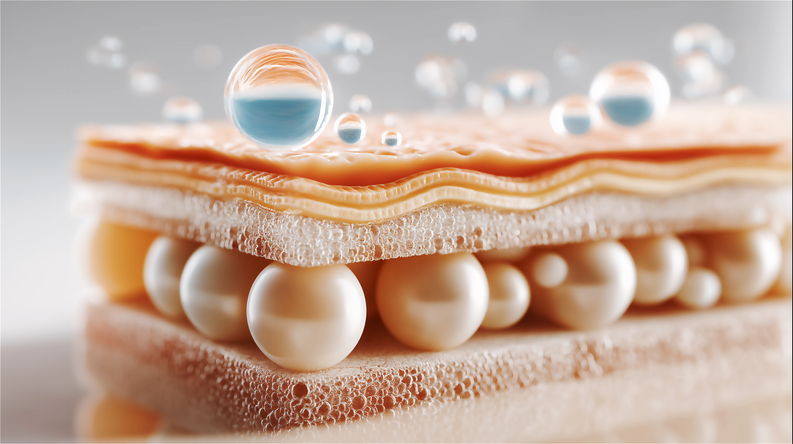
Why does skin texture suddenly deteriorate?
To understand dead skin cells and skin texture issues,
you must first understand the skin's natural regeneration system.
The skin constantly creates new cells
and repeats the process of pushing old cells outward.
This is called 'skin turnover.'
In healthy skin, this cycle occurs regularly
at intervals of approximately 4 weeks.
It can be understood as a process similar to house cleaning,
where old things are cleared out and replaced with new ones on time.
But what happens if this cycle is disrupted or slowed down?
Old dead skin cells accumulate on the skin surface,
and as new cells cannot rise properly, the skin texture
becomes rough and appears dull.
Makeup not adhering evenly
and the skin looking generally heavy
often stem from these reasons.
Major Factors Disrupting Skin Turnover Rhythm
Excessive or imbalanced sebum secretion
Decline in skin barrier function
Cumulative UV exposure
Changes in lifestyle (lack of sleep, dietary habits, stress)
Irregular skincare routine
It is rare for only one of these to apply;
usually, multiple factors work in combination.
That is why simple moisturizing or exfoliating products have their limits.
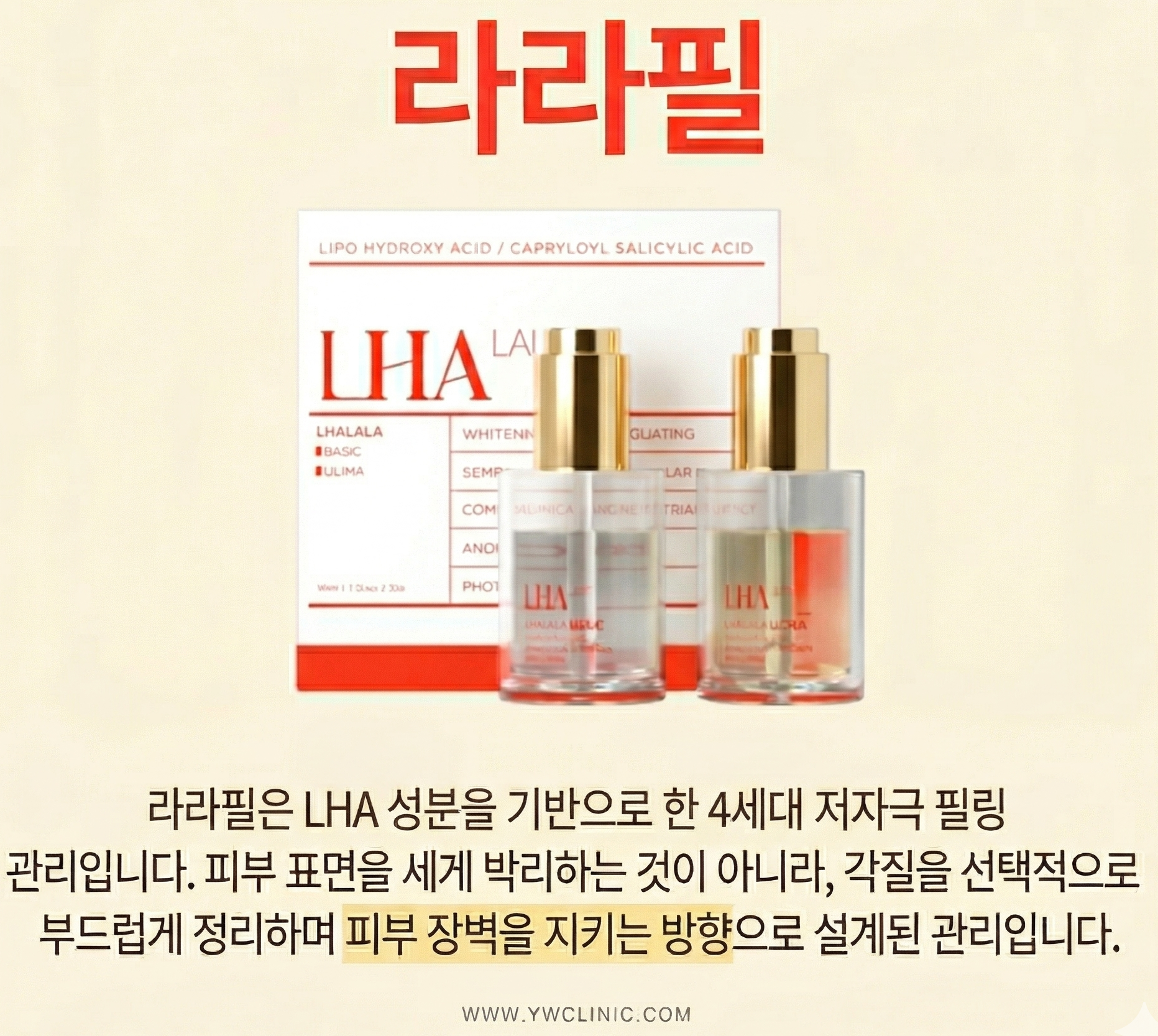
What is Hongdae Lala Peel?
Lala Peel is a 4th-generation hypoallergenic peeling treatment based on LHA ingredients.
When people hear 'peeling,' many imagine a procedure
that aggressively strips the skin and feel burdened by it.
However, Hongdae Lala Peel has a completely different approach
from conventional harsh chemical peels.
Instead of forcefully exfoliating the skin surface,
it is designed to selectively and gently refine dead skin cells
while simultaneously protecting the skin barrier.
The core ingredient,LHA (Lipohydroxy Acid),is
gentler and more delicate in action than the well-known AHA or BHA.
Rather than irritating the entire skin, it has the characteristic of
selectively removing dead skin cells where needed,
making it applicable even to sensitive skin with relatively no burden.
It also works effectively to clear sebum and impurities within the pores.
This is also why Lala Peel is more than just a simple exfoliation treatment.
It includes ingredients that protect the skin barrier,
approaching the treatment in a way that aids the overall recovery of skin condition
while refining dead skin cells.
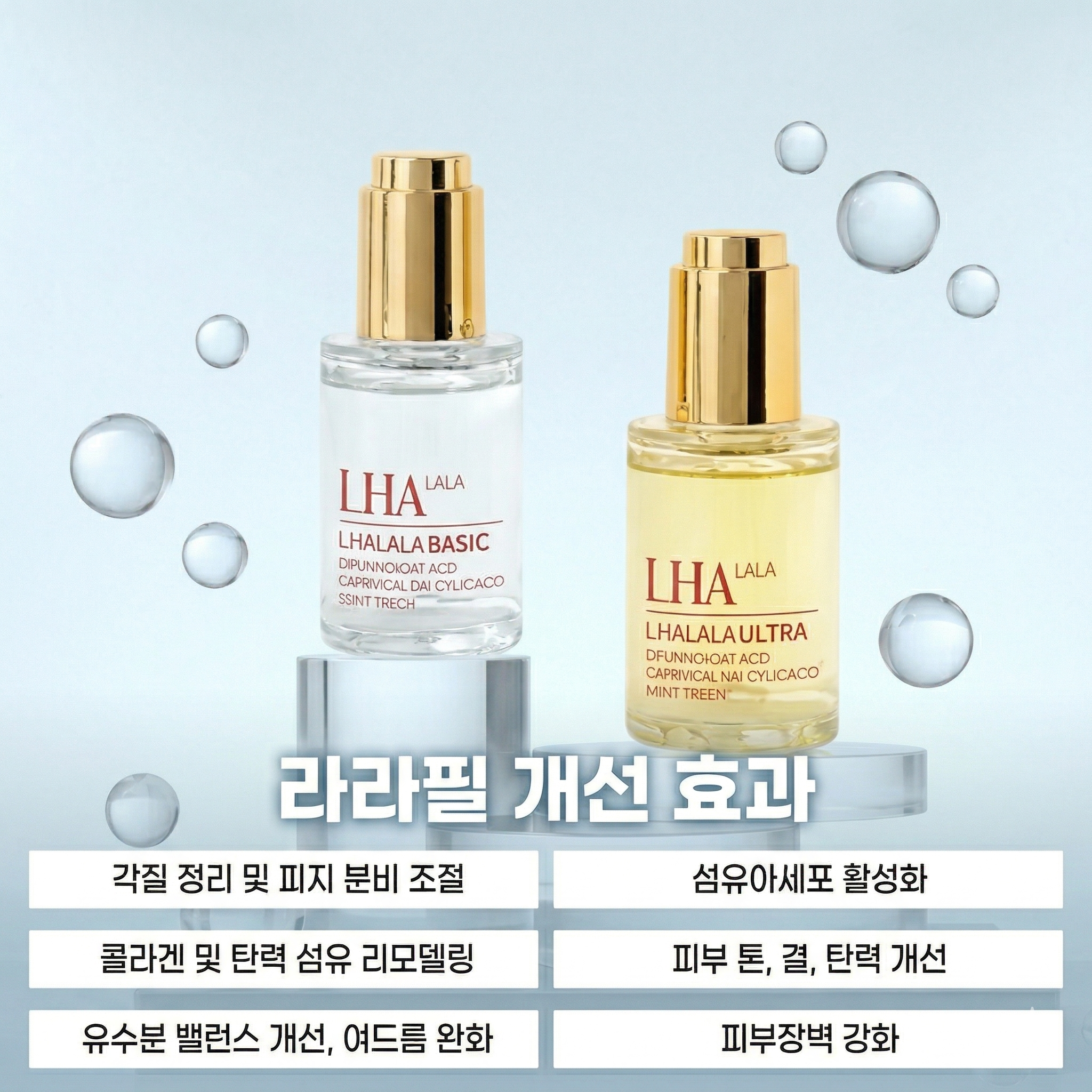
Summary of Key Features of Hongdae Lala Peel
① 4th Generation Hypoallergenic Peeling
The irritation is significantly lower than conventional peeling treatments,
so those with sensitive skin or those who experienced discomfort
from previous peeling experiences can receive it relatively comfortably.
② Selective Dead Skin Care with LHA Ingredients
Instead of uniformly irritating the entire skin,
it selectively refines areas where dead skin cells have accumulated.
This allows for sufficient removal of sebum within pores
and old dead skin cells while reducing irritation.
③ Simultaneous Skin Barrier Protection
Skin barrier protection ingredients work simultaneously while removing dead skin cells.
There is less discomfort, such as the skin suddenly becoming sensitive or dry after treatment.
④ Relatively Fast Return to Daily Life
The recovery process is simpler compared to aggressive peeling procedures.
Most people can resume light daily activities on the same day after treatment.
⑤ Suitable for Repeated Treatment
Rather than a single intensive session,
cumulative improvement in skin texture and tone can be expected through consistent repetition.
Post-Treatment Precautions
Following these instructions after Lala Peel treatment will help maintain the effects better.
Avoid direct sunlight, saunas, and strenuous exercise for 24–48 hours immediately after treatment.
Moisturizing and sun protection are the two most important things after treatment.
It is recommended to temporarily stop using harsh scrubs, retinol, and high-concentration AHA/BHA products
for a certain period after treatment.Mild redness, heat sensation, or fine flaking of dead skin cells are temporary reactions
and usually subside naturally. Do not remove them forcibly.
This treatment is well-suited for those who:
Have generally rough skin texture and makeup that does not adhere well
Have dull and dark-looking skin due to repetitive accumulation of dead skin cells
Have enlarged pores or difficulty managing sebum
Have experienced skin irritation after previous aggressive peeling procedures
Have hesitated to get peeling treatments due to sensitive skin
Want to even out their skin tone
However, if you currently have severe active inflammatory acne
or a skin disease, a consultation with a specialist is mandatory before treatment.
Frequently Asked Questions (FAQ)
Q1. Can I feel the effects immediately after one session?
Some people feel their skin texture is refined even after a single treatment.
However, since substantial changes in skin texture and tone
accumulate through consistent repeated treatments,
it is effective to establish a long-term care plan.
Q2. Can I apply makeup immediately after treatment?
In most cases, basic skincare and light makeup are possible on the same day.
However, as it may vary depending on skin condition,
please follow the instructions of the medical staff after treatment.
Q3. My skin is very sensitive; can I still receive it?
Since Hongdae Lala Peel is based on a hypoallergenic design,
it is often applicable even to sensitive skin.
However, since suitability for the treatment may vary
depending on individual skin conditions, we recommend deciding after an in-person consultation.
Q4. What is the difference between a regular peel and Lala Peel?
General chemical peels vary greatly in irritation level and recovery period
depending on the concentration and type of ingredients.
Lala Peel protects the skin barrier based on LHA ingredients
while selectively refining dead skin cells,
resulting in relatively less irritation and recovery burden.
Q5. Are there any side effects?
Temporary redness, sensitivity, or fine flaking of dead skin cells may occur,
but most subside naturally.
Please avoid using strong irritating ingredients or excessive friction after treatment.
Since reactions may vary depending on individual skin conditions,
please visit the clinic immediately if abnormal reactions persist.
Skin texture and dead skin cell concerns are often not solved
simply by changing cosmetics.
It is much more important to understand the skin condition itself
and design a treatment direction that suits it.
Hongdae Lala Peel is a treatment that approaches skin care by minimizing irritation
while refining the skin's natural regeneration environment.
It is a well-suited treatment for those who desire
steady, cumulative skin improvement rather than a single dramatic change.
At Cleor Clinic Hongdae Branch, we closely assess
the skin condition of our visitors
and provide guidance on the appropriate treatment direction for each individual.
If your skin texture concerns have persisted for a long time,
checking your skin condition through a professional consultation
can be a great start.
※ This content is for general informational purposes, and results may vary by individual. Please decide on accurate diagnosis and treatment through a consultation with a specialist.