

Hello.
I am Dr. Kim Dong-young, Director of Cleor Clinic Hongdae Branch.
There is a moment when you first check your profile view after taking an ID photo.
While the front view is familiar, the side view can feel unfamiliar even to yourself,
and you may find yourself staring at it for a long time because the area under the chin looks somewhat flat.
This is a story I hear quite often during consultations.
A receding chin is often not due to having too much fat.
Your impression from the side is determined by the front-to-back relationship between three points: the tip of the nose, the lips, and the tip of the chin.
If the forward projection of the chin is insufficient among these, the lower face can look short and pushed back, even if the face is the same.
Today, I will explain in order what a receding chin filler treatment at our Hongdae branch is, what hyaluronic acid is as a substance,
why different formulations are used for different areas, why it is placed in deep layers,
and points you should be aware of in advance.
What is a receding chin filler in Hongdae?
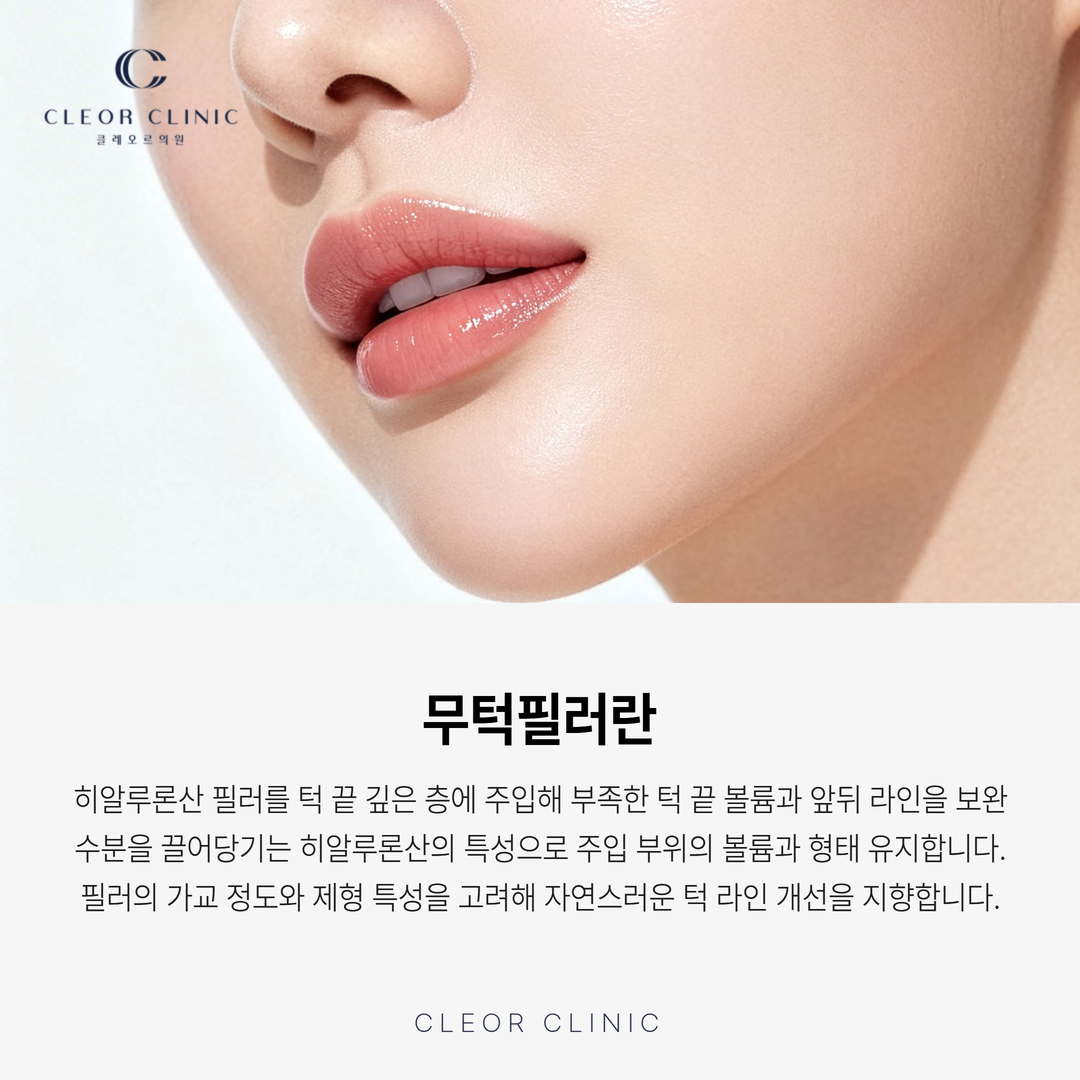
👉 A receding chin filler is a treatment that adjusts the front-to-back relationship in the profile by placing a hyaluronic acid product in the deep layers of the chin tip that appears to lack forward projection.
The hyaluronic acid used here is not a strange substance created externally,
but a polysaccharide that already exists in our body's dermis and joint fluid.
It has a structure where sugar units are linked like a long chain,
and it has the property of attracting and holding moisture around the chains, maintaining volume at the injected site.
However, if left as is, the body's hyaluronic acid decomposes quickly and cannot maintain its shape for long.
Therefore, filler products undergo a cross-linking process, where bridges are placed between chains to weave them like a net.
The denser this cross-linking, the greater the property to maintain its shape even when pressed by external force,
and the looser it is, the more it spreads softly and dissolves well into the surface.
This is why even the same hyaluronic acid has different characteristics depending on the formulation.
The strengths of choosing the right physical properties and layers for receding chin filler
👉 You can choose the physical properties suitable for the nature of the area and decide which layer to place it in.
First, choose the physical properties suitable for an area that needs to be supported and lifted.
The tip of the chin is not an area that should be spread thinly like under the eyes.
It is an area where the shape must be built up by supporting it from below.
Because force is constantly applied from below while speaking, chewing food, and making expressions,
a firm formulation that does not yield to pressing force and maintains its shape is used in this area.
If a soft formulation is used here, it easily spreads to the sides and the shape becomes blurred,
so choosing the right product is as important as where you place it.
Second, placement in the deep layer just above the periosteum.
Muscles are gathered around the tip of the chin, so if placed in a layer close to the surface,
it is easy for it to be pushed by movement and leave a feeling of being palpable.
On the other hand, if placed in a deep layer just above the thin membrane covering the bone,
the hard bone supports it from behind, and the force is transmitted forward.
Thanks to the thickness of the muscles and skin covering it, there is less of a lump feeling on the surface.
Therefore, even with the same amount, the degree to which the side line stands out depends on which layer it is placed in.
Third, it can be distributed in portions, leaving room for reversal.
It is known that hyaluronic acid products can be induced to decompose using a degrading enzyme called hyaluronidase.
Since there is room for adjustment, we do not inject a large amount at once,
but can capture the distribution while checking it little by little.
In areas like the side line, where the impression changes significantly even with a slight change in angle,
this flexibility helps in making decisions.
I will be honest about one thing.
If the cause is the position of the jawbone itself or the state of the upper and lower teeth alignment,
it is outside the scope of what can be handled with fillers and requires a separate diagnosis first.
Therefore, this treatment is not an item that changes the skeletal structure.
It is more accurate to approach it with the strength of supplementing the lacking forward support in the side line.
The principle of how receding chin filler works
👉 By adding support below the point that has receded in the side line, it adjusts the angle to come forward.
What creates an impression in a profile is not just the tip of the chin, but the front-to-back relationship formed by the tip of the nose, lips, and the tip of the chin.
If the forward projection of the chin is insufficient among these,
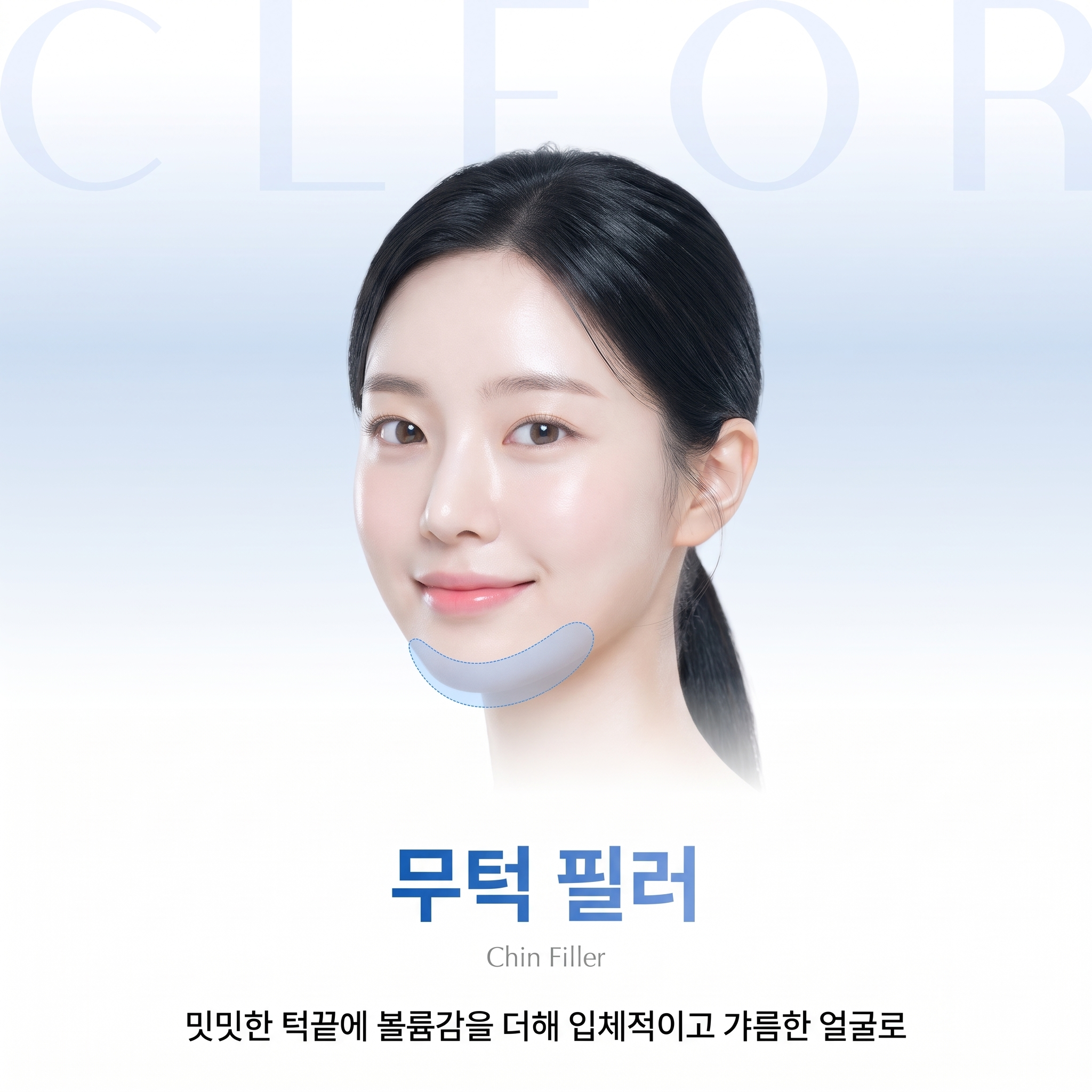
it becomes a shape where only the chin is tucked in on the side line connecting the three points.
Then, an impression remains where the lower face looks short and pushed back.
This is why it is often a problem of front-to-back relationship rather than having too much chin fat.
If you add support just above the periosteum here, the angle at which the chin tip comes forward changes.
Since the hard bone is supporting it from behind, the added volume does not scatter to the sides but faces forward.
The angle at which the side line continues also becomes smoother.
Because the distribution changes depending on whether you want to bring it forward or see the length downward,
the ratio of division is different even for the same area when the chin looks short versus when it looks pushed back.
If the forward support of the chin tip is insufficient, the skin above it may lose its place and fold at the bottom,
creating a shape where the area under the chin looks thick.
When support is created in the front, it is reported that this folding looks less prominent,
and those who felt that the area under their chin always looked thick regardless of their weight often recall this point.
Procedure method and composition
👉 Since filler is an item where you choose the product rather than the equipment, which formulation is placed at what depth becomes the center of the composition.
Cleor Clinic Hongdae Branch carries domestic lines, domestic premium lines, and imported lines such as Belotero and Juvederm.
All use hyaluronic acid as the main ingredient,
and their soft or firm properties vary depending on the degree to which the chains are linked together.
For areas that need to be supported and lifted like the tip of the chin, the strength to maintain the shape is needed,
so a firmer formulation is placed at a depth close to the bone.
Conversely, a softer one is suitable for areas placed shallowly near the surface.

When the shape needs to be reversed, we use hyaluronidase, which decomposes hyaluronic acid.
Even with the same product, the shape seen from the side line varies depending on how deep and how much is placed.
Which line to go with is decided after checking the thickness of the chin tip skin and the front-to-back drop.
If you have a profile like this
Those who feel that their chin tip looks pushed back in profile photos
Those whose lower face looks short because their chin tip looks less projected than their lip line
Those who think the area under their chin always looks thick regardless of their weight
Those whose front view is fine but whose impression looks different only from a side angle
Those who want to tidy up the balance of their side line rather than a big change
Types of fillers in Hongdae
👉 Filler items are divided according to which point is misaligned front-to-back when viewed from the side.
If you trace the side line from the forehead to the tip of the chin,
the Hongdae branch items are divided into areas as follows.
Receding chin filler and chin tip filler use overlapping areas, but their purposes are not the same.
It is accurate to understand that receding chin is closer to looking at the front-to-back relationship that has receded,
and chin tip is closer to refining the length and shape.
Possible reactions and points to note
👉 It is reported that most points to note are limited to temporary changes and subside over time.
⚠️ Precautions before and after the procedure
❓ Frequently Asked Questions (FAQ)

Q. Why do you use a firm formulation?
A. Because the tip of the chin is not an area to be spread thinly, but an area where the shape must be built up by supporting it from below.
It is an area where force is constantly applied while speaking, chewing, and making expressions, so a formulation with dense cross-linking between chains that does not yield to pressing force is used.
Q. Why do you put it in a deep layer?
A. If placed just above the membrane covering the bone, the hard bone supports it from behind, and the force is transmitted forward, and thanks to the muscles and skin covering it, there is less of a lump feeling on the surface.

If it gathers near the surface, it is easy to be pushed by muscle movement and be palpable.

Q. How are receding chin filler and chin tip filler different?
A. Receding chin is closer to looking at the front-to-back relationship where the chin tip has receded in the profile,
and chin tip is closer to refining the length and shape.
Since the areas can overlap, we divide the scope during the consultation.
Q. Can I reverse it if I don't like it?
A. It is known that hyaluronic acid products can be induced to decompose with a degrading enzyme called hyaluronidase.
However, since the judgment varies depending on the condition, it needs to be checked during the consultation.
Q. Are there cases where fillers don't work and a different approach is needed?
A. If the cause is the position of the jawbone or the state of the upper and lower teeth alignment, it is outside the scope of what can be handled with fillers.
Therefore, we check this distinction first during the consultation stage and set the direction.
Q. Can I go to work right after getting it?
A. Redness and swelling may remain for a few days, so if you have an important schedule, it is more comfortable to have some leeway.
Returning to daily life itself is not difficult.
Receding chin filler in Hongdae is not a procedure to make the chin large, but a treatment to adjust the angle by supplementing the forward support that was lacking in the side line.
We choose a firm formulation suitable for the area to be supported and lifted, and place it in a deep layer just above the periosteum so that the force is directed forward.
Even with the same side line, the position of the jawbone, skin thickness, and expression habits are all different, so the injection site and distribution are not fixed as one.
At Cleor Clinic Hongdae Branch, we check these parts directly during the consultation.
We also operate items that look at the lower face together, such as chin tip filler or front cheek filler, so you can look at the scope separately.
If you have been bothered by your profile photos, please feel free to have a conversation with us.
※ This content is for general information purposes only, and changes that appear may vary depending on the individual.
Please determine the exact diagnosis and whether to proceed with the procedure through a consultation with a specialist.
그래서 진료 단계에서 이 구분을 먼저 확인하고 방향을 잡습니다.
Q. 맞고 바로 출근해도 되나요?
A. 붉은기와 부기가 며칠 남을 수 있어, 중요한 일정이
있다면 여유를 두시는 편이 편합니다.
일상으로 돌아가는 것 자체는 어렵지 않은 편입니다.

홍대 무턱필러는 턱을 크게 만드는 작업이 아니라, 옆선에서
부족했던 앞쪽 지지를 보충해 각도를 조정하는 케어입니다.
받쳐 올리는 자리에 맞는 단단한 제형을 고르고,
그것을 뼈막 바로 위 깊은 층에 두어 힘이 앞쪽으로 향하게 합니다.
같은 옆선이어도 턱뼈의 위치와 피부 두께,
표정 습관이 모두 달라 주입 자리와 배분이 하나로 정해지지는 않습니다.
클레오르의원 홍대점에서는 이런 부분을 상담 시 직접 확인해 드립니다.
턱끝필러나 앞볼필러처럼 아래 얼굴을 함께 보는 항목도 운영하고
있어 범위를 나누어 보실 수 있습니다.
옆모습 사진이 자꾸 신경 쓰이셨다면, 편하게 한 번 이야기 나눠 보셔도 좋겠습니다.
※ 본 내용은 일반적인 정보 제공을 위한 글이며, 개인에 따라 나타나는 변화는 달라질 수 있습니다.
정확한 진단과 시술 여부는 전문의 상담을 통해 판단하시기 바랍니다.