
Hello.
I am Director Dong-young Kim of Cleor Clinic Hongdae Branch.
One of the biggest reasons patients hesitate to undergo procedures in the treatment room is pain.
"I want to get Ulthera, but I've heard the pain is too scary."
"I heard Rejuran treatments are quite stinging; will I be able to endure it?"
"Sleep anesthesia feels like too much, but numbing cream alone doesn't seem like enough."
Surprisingly, many people postpone the procedures they want because of pain.
What is just as important as the results of the procedure
is the comfort during the process of undergoing it.
Today, for those looking into Airnox in Hongdae,
I will explain the non-sleep inhalation anesthesia option that reduces the burden of pain.
I will provide an honest explanation.
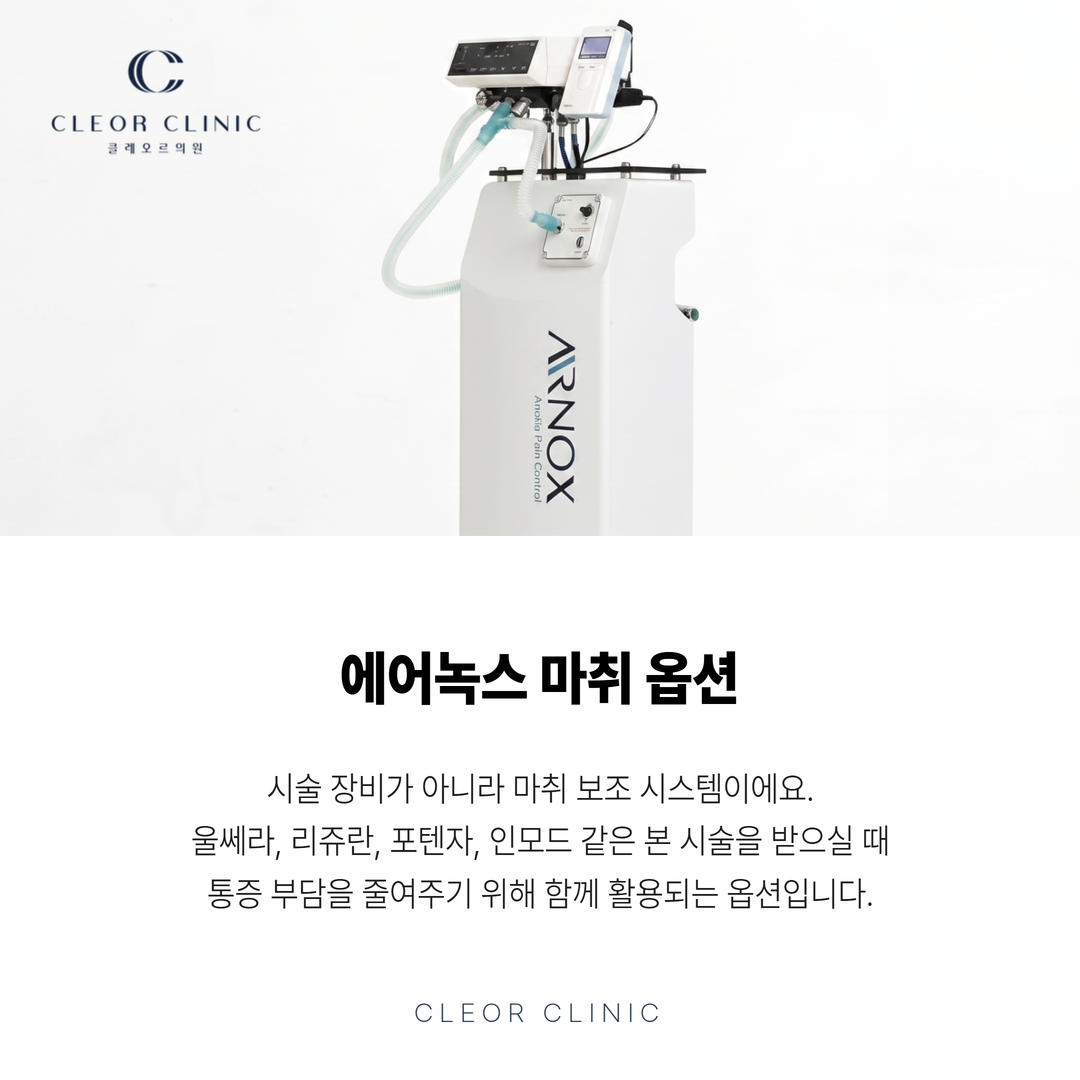
Airnox is an anesthesia option, not a procedure.
There is something I need to clarify first.
Airnox is different in nature from the procedures covered in other columns.
It is an auxiliary anesthesia system, not a treatment device.
When undergoing primary procedures such as Ulthera, Rejuran, Potenza, or InMode,
it is an option utilized together to reduce the burden of pain.
To put it simply,
Airnox itself is not a procedure that acts directly on the skin,
but a tool that makes it more comfortable to receive other treatments.
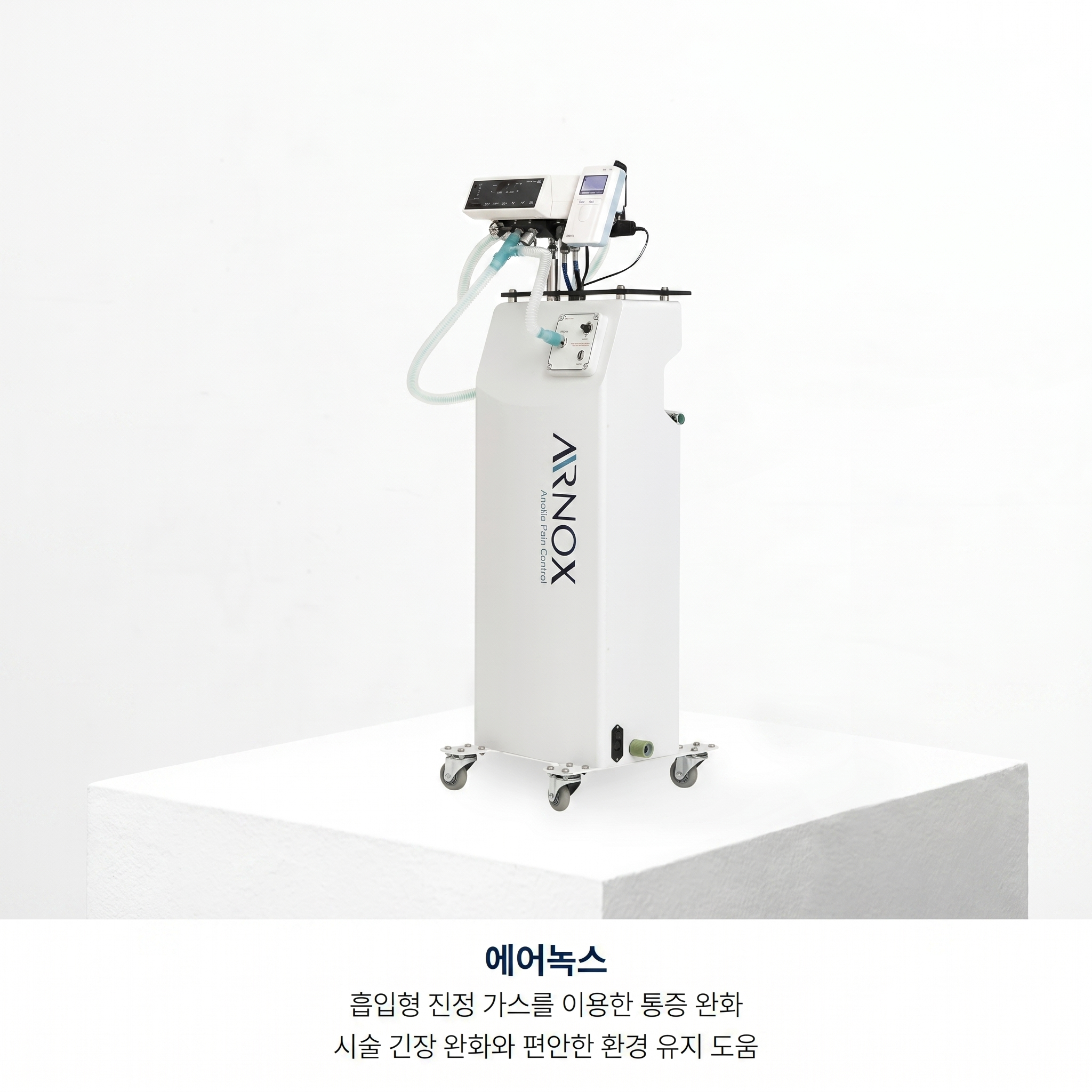
What is Hongdae Airnox?
Hongdae Airnox is
a system that precisely mixes nitrous oxide (N₂O) and oxygen (O₂) for inhalation
as a non-sleep pain control system.
The inhaled gas enters the bloodstream through the lungs,
temporarily sedating the central nervous system.
It does not block the pain itself,
but rather works by reducing the sensitivity to pain.
To use a simple analogy,
it is similar to turning down the speaker volume rather than turning it off.
The sound (pain) still comes through, but the volume is lowered, making it easier to endure.
History — Proven Medical Technology
Inhalation sedation using nitrous oxide
is a proven method that has been used in birthing centers and dental clinics since the 1800s.
Recently, its use has been increasing in the field of aesthetic medicine.
It is a medical device approved by the US FDA,
and is becoming a standard option in aesthetic clinicsacross many countries worldwide.
Anesthesia Options at a Glance
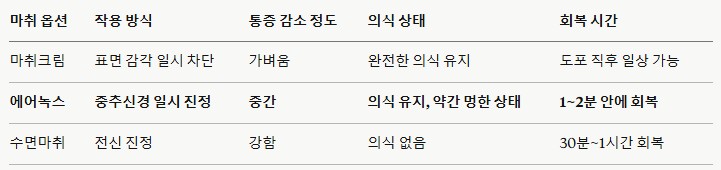
There are typically three anesthesia options used in skin procedures.
The Position of Airnox
It is suitable for those who find numbing cream insufficient
but find sleep anesthesia to be a burden,
serving as an intermediate-level anesthesia option.
Advantages of Hongdae Airnox
1) Non-sleep — Consciousness is maintained
You may feel slightly dazed during the procedure, but you can communicate with the medical staff.
Since consciousness does not completely disappear as it does with sleep anesthesia,
it is suitable for those who feel burdened by deep anesthesia.
2) Fast Recovery — Return to daily life within 1-2 minutes
The effects wear off quickly once you stop inhaling the gas.
You can get up and return to your daily routine within 1-2 minutes after the procedure.
Compared to sleep anesthesia, which requires several hours of rest and a guardian,
this is a much less burdensome method of anesthesia.
3) Precise Concentration Control
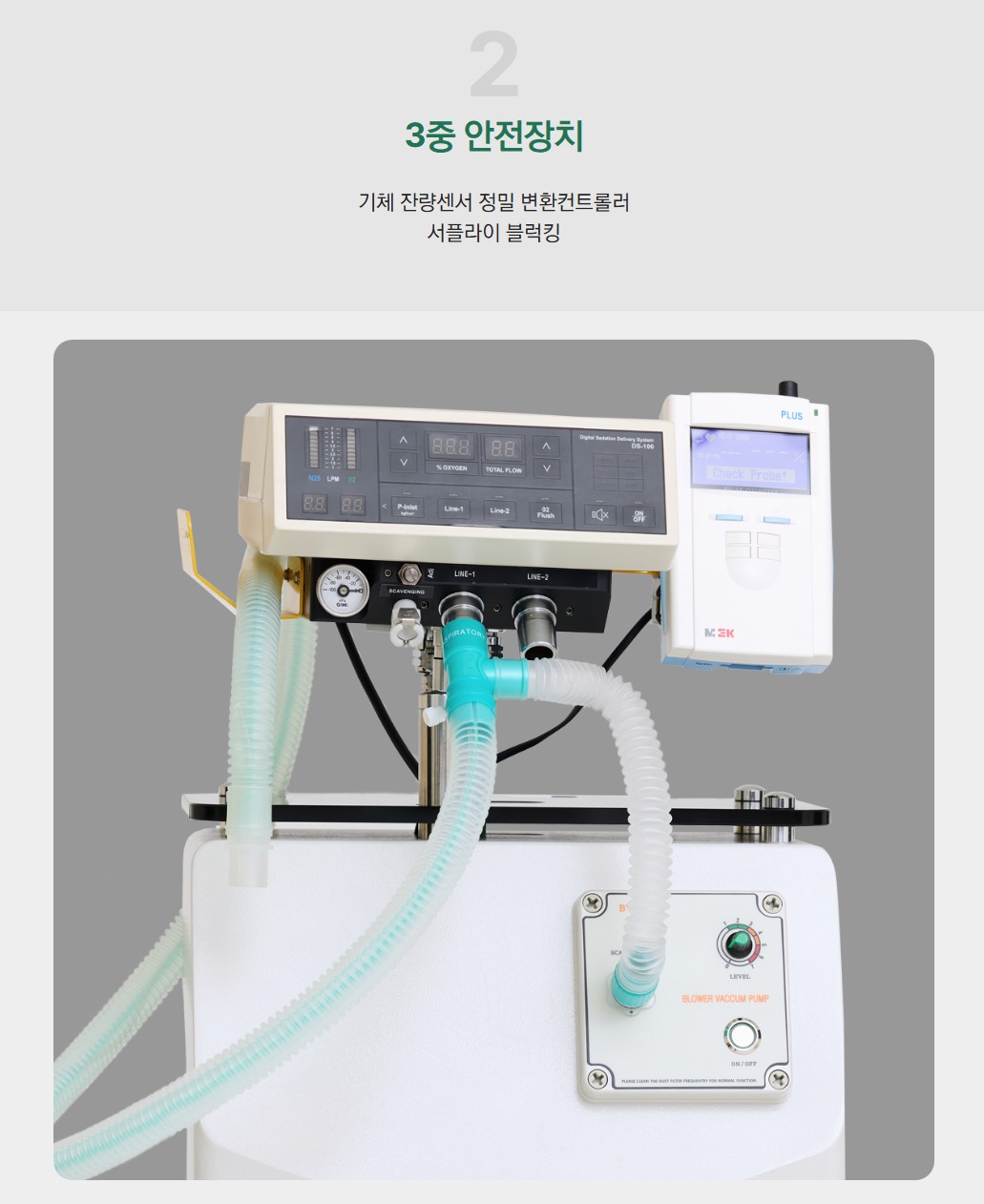
After the medical staff checks the patient's physique, respiratory volume, and sensitivity in advance,
the gas concentration is adjusted in real-time.
Because it is adjusted while monitoring the pain level and sedation state during the procedure,
both over-sedation and under-sedation can be avoided.
4) Disposable Sterile Filters
Since it involves inhalation, hygiene is crucial.
Airnox uses individually sterile-packed filters and mouth filters, all of which are disposable.
It prevents contamination from bacteria, germs, and viruses,
and its structure perfectly blocks saliva and moisture.
5) Proven Safety
This method has been used for children in birthing centers and dental clinics.
It is a proven system that has been utilized for a long time as a US FDA-approved medical device.
6) Avoiding the Burden of Sleep Anesthesia
Sleep anesthesia requires more care as consciousness is lost.
It requires fasting, a guardian, post-procedure rest time, and no driving,
but Airnox has almost none of these burdens.
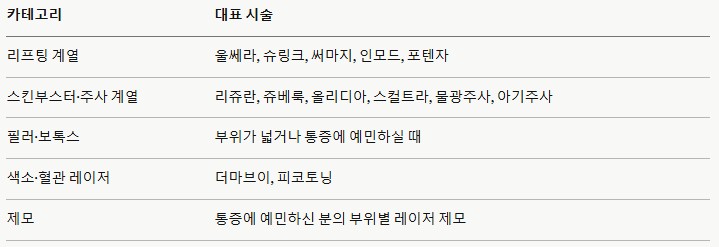
Which procedures is it used with?
Hongdae Airnox is used with various procedures that involve a burden of pain.
Lifting Category
Ulthera
Shurink
Thermage
InMode
Potenza
Skin Booster & Injection Category
Rejuran
Juvelook
Olidia
Sculptra
Hydro-injection
Baby Injection
Filler & Botox
Pigmentation & Vascular Lasers
Derma V
Pico Toning
Hair Removal
For most procedures that involve pain,
it can be considered as a combined option.
Recommended for the following individuals
Those who are sensitive to pain and are postponing the procedures they want
Those who felt that numbing cream alone was insufficient
Those who find sleep anesthesia to be a burden
Those who need to return to daily life quickly after the procedure
Those who cannot be accompanied by a guardian
Those who are very nervous because it is their first procedure
Those looking into procedures accompanied by pain, such as Ulthera or Potenza
Cases that must be checked during the pre-consultation
While Airnox is a safe method, its use is restricted in the following cases.
If you are pregnant or breastfeeding
If you have chronic lung disease (COPD, asthma attacks, etc.)
If you have nasal obstruction (severe cold with congestion, rhinitis attacks)
If you have been diagnosed with otitis media (middle ear infection)
If you have been diagnosed with Vitamin B12 deficiency
If you have decreased oxygen saturation
If you have a recent history of diving (related to decompression)
If you have severe claustrophobia (burden of wearing a mask)
We will verify these during your pre-consultation.
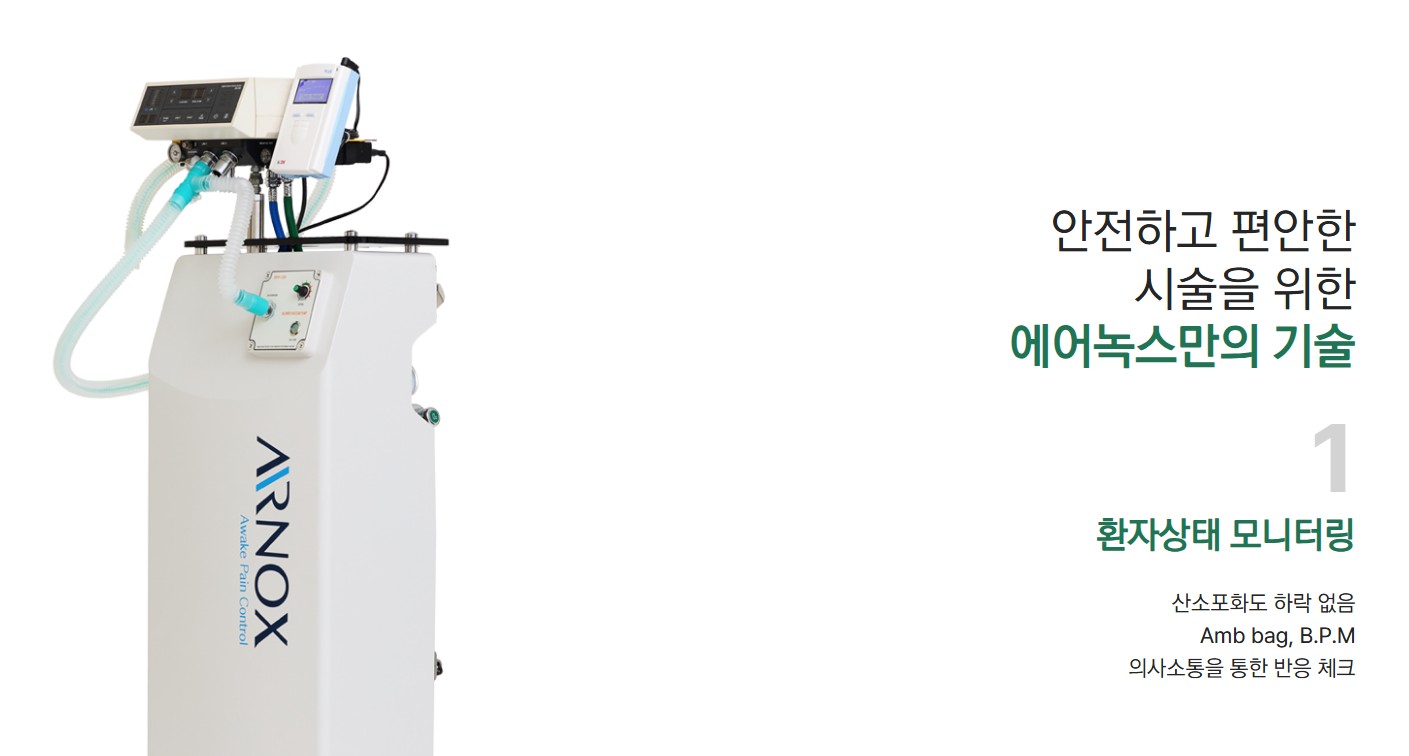
Airnox Procedure Process
It involves inhalation through a mask or mouthpiece immediately before the procedure.
Step 1 — Pre-check
We check respiratory volume, physique, sensitivity, and underlying conditions.
We set the gas concentration and oxygen ratio to suit the patient.
Step 2 — Start Inhalation
Place the mask lightly over the nose and mouth and breathe normally.
The sedation effect begins to appear within 1-3 minutes.
Step 3 — Procedure
Once the sedation state is stable, the primary procedure begins.
The medical staff checks the patient's condition throughout the procedure
and adjusts the gas concentration.
Step 4 — Recovery
Once the procedure is finished, the gas supply is stopped.
As the remaining gas is exhaled,
you return to a state of full consciousness within 1-2 minutes.
Most patients can get up and return to daily life immediately after the procedure.
What does it feel like during the procedure?
This is what first-time patients are most curious about.
Start
After 1-2 minutes, your head begins to feel slightly light.
Some people feel their hands and feet becoming slightly warm.
Sedation State
A slightly dazed and dreamy feeling
A feeling that time is passing faster than usual
A feeling as if the procedural pain is coming from a distance
Mild dizziness
A feeling that sounds are slightly distant
Although the experience varies from person to person,
most describe it as a light state of sedation, similar to having a glass of alcohol.
Consciousness is maintained
You can answer when the medical staff speaks to you,
and you can request to stop during the procedure if necessary.
Some people find their memory becomes hazy,
while others remember everything clearly.
⚠️Post-Procedure Precautions (When using Airnox)
While recovery from the anesthetic itself takes 1-2 minutes,
there are things to be mindful of for a few days.
Driving on the day of the procedure is discouraged
Although it is a fast-recovery anesthesia method,
residual dizziness may last for several hours depending on the individual,
so it is safer to avoid driving on the same day if possible.
Adequate Hydration
Temporary dry mouth may occur after gas inhalation,
so it is good to drink plenty of lukewarm water after the procedure.
Light Meals
Eating is possible after the procedure,
but it is safer to stick to light meals immediately after sedation.
Symptoms to report immediately
If headache, nausea, or dizziness persists for more than a few hours,
please inform the medical staff according to the instructions provided beforehand.
Points to Note in Advance
Airnox is not a universal anesthetic.
1) It does not completely replace local anesthesia
Airnox works by sedating the central nervous system.
It is different from numbing creams or local anesthetics that directly block peripheral sensations,
so for procedures with high pain, it is often used in conjunction with numbing cream or local anesthesia.
2) There are significant individual differences in sedation levels
Even with the same concentration inhaled,
the perceived level of sedation can vary from person to person.
It is known that those with low alcohol tolerance tend to react more strongly to Airnox.
3) It is not suitable for all procedures
It may be inefficient for very short procedures or those with almost no pain,
so the medical staff will review and decide on its recommendation during the pre-consultation.
4) Possibility of Residual Dizziness
Most recover within 1-2 minutes,
but sensitive individuals may have a residual feeling for several hours, so it is best to avoid a busy schedule on the day of the procedure.
We will verify this during your pre-consultation.
❓ Frequently Asked Questions
Q. Will I lose consciousness?
No.
Airnox is a non-sleep method that reduces pain sensitivity while maintaining consciousness.
You can communicate with the medical staff and express yourself during the procedure.
Q. How is it different from sleep anesthesia?
Sleep anesthesia is a general sedation method where consciousness is completely lost.
Airnox is a method that only reduces pain while consciousness is maintained,
so the recovery time is much shorter and a guardian is not mandatory.
Q. Will I lose my memory during the procedure?
Some people find their memory becomes hazy, while others remember everything clearly.
This varies from person to person.
Q. Can children receive it?
It is a method that has been used for children in dental clinics.
However, in the field of aesthetic procedures, it is generally operated for adults.
Q. Can I skip the numbing cream?
Airnox is a central sedation method and does not directly block peripheral sensations.
For procedures with a high burden of pain, it is often used
together with numbing cream, which we will explain during your pre-consultation.
Q. Will it feel suffocating during the procedure?
It is a mask type that gently covers the nose and mouth.
If you have severe claustrophobia, please let us know in advance, and we will review it together.
Q. Can I drive home immediately?
Recovery is complete within 1-2 minutes, but due to the possibility
of residual dizziness, it is safer to avoid driving on the day of the procedure if possible.
Q. What are the possible side effects?
Temporary dizziness, nausea, headache, and dry mouth may occur.
Most symptoms subside quickly once the gas supply is stopped.
Rarely, changes in oxygen saturation have been reported, so the medical staff monitors the patient's condition throughout the procedure.
If you have a procedure you want to receive but have been postponing it due to pain,
Airnox is an anesthesia option worth looking into.
It is not the procedure itself,
but a tool for comfort during the process of undergoing the procedure.
For those who find numbing cream insufficient but sleep anesthesia to be a burden,
it is a method of anesthesia utilized as an intermediate-level option.
As an inhalation anesthesia that precisely mixes nitrous oxide and oxygen,
Maintenance of Consciousness
Fast Recovery
Disposable Sterile Filters
Proven Safety
it is a non-sleep anesthesia system with four key advantages.
If you are hesitating to undergo a procedure due to the burden of pain,
please feel free to contact Cleor Clinic Hongdae Branch.
※ This content is for general informational purposes, and results may vary depending on the individual.
Please decide on an accurate diagnosis and whether to proceed with a treatment through a consultation with a specialist.