
Hello.
I am Dr. Dong-young Kim, Director of Cleor Clinic Hongdae Branch.
"I squeeze the blackheads on my nose tip over and over,
but they reappear just a few days later."
"When I peel off a nose pack, the black dots seem to disappear for a moment,
but they soon return, which is frustrating."
"Even between my eyebrows and along the brow line,
there seem to be tiny black dots embedded."
If you have been squeezing them or using nose packs every time
without seeing any real change,
there is a possibility that those black dots are not blackheads.
Today, I will explain Trichostasis Spinulosa,
a condition that surprisingly many people are unaware of,
and introduce Hongdae Facial Hair Removal,
a gentle way to manage this condition.
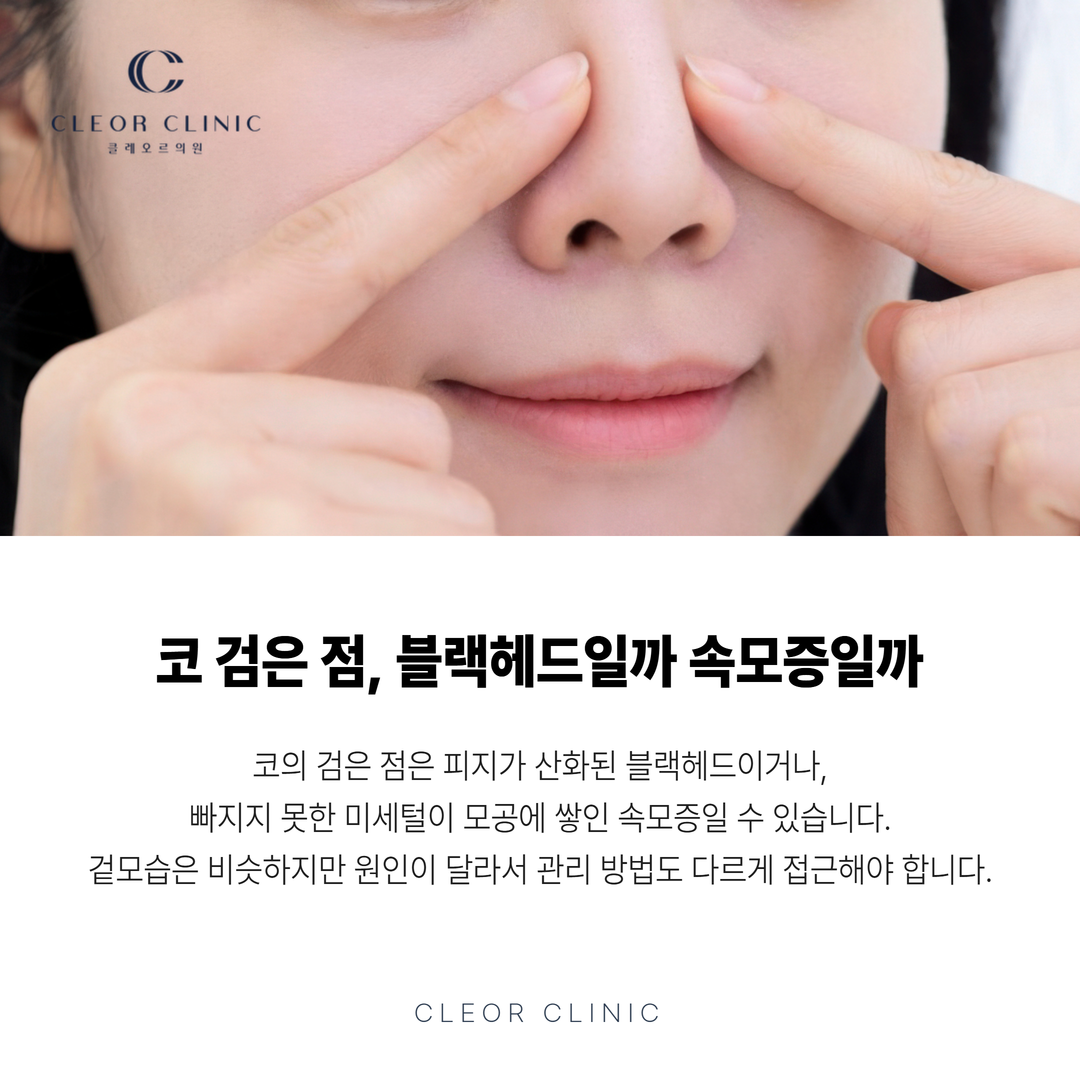
Black dots on the nose: Are they blackheads or Trichostasis Spinulosa?
Blackheads and Trichostasis Spinulosa are completely different conditions.
While they look similar on the surface,
their causes and solutions are entirely different.
Blackheads (Sebum Oxidation)
This occurs when sebum accumulated in the pores meets the air,
oxidizes, and turns black.
The causes are sebum and impurities.
Trichostasis Spinulosa
The cause is not sebum, but fine black hairs.
Normally, body hair follows a cycle of
Anagen → Catagen → Telogen,
where hair that has passed the resting phase naturally
sheds and a new hair grows in its place.
When this cycle is disrupted,
fine vellus hairs that should have shed remain and accumulate in the pore,
resulting in multiple fine hairs
clumped togetherwithin a single pore.
In severe cases, reports have shown
more than 25 vellus hairs clumped in one pore.
To put it simply,
it is like multiple cords tangled into a single outlet,
making it look like a black mass.
Why is squeezing blackheads ineffective?
This is a crucial point.
Many people think they are blackheads
and continue to squeeze them or use nose packs,
but if it is Trichostasis Spinulosa, squeezing will not solve the problem.
In fact, it may irritate the pore opening, causing it to widen
or leave hyperpigmentation marks.
👉Furthermore, since the fine hairs are located deep inside the hair follicle,
the pressure from squeezing the surface
makes it structurally difficult to remove them fundamentally.
It is similar to the difference between cutting only the leaves of a weed
and pulling it out by the roots.
The condition requires addressing the root (hair follicle) for proper management.
An effective method for this
is the Hongdae Facial Hair Removal treatment I am introducing today.

Hongdae Facial Hair Removal: Fotona StarWalker
Hongdae Facial Hair Removal is a procedure that uses laser energy
to deliver stimulation to the roots of fine hairs.
At Cleor Clinic Hongdae Branch,
we perform this using the Fotona StarWalker.
What is Fotona StarWalker?
It is a multi-wavelength Nd:YAG laser device
manufactured by Fotona in Slovenia.
It is a multi-platform laser that can be used for
precise pigment breakdown, laser toning, and hair removal.
Principle of Operation
As laser energy is selectively absorbed
by the melanin pigment within the hair,
thermal energy is delivered to the hair root (dermal papilla).
This stimulation weakens the activity of the hair root,
managing the cycle so that fine hairs
do not grow back as quickly.
The key is to selectively target areas with dark pigment
while minimizing the impact on the surrounding normal skin.
Which areas can be treated?
Hongdae Facial Hair Removal is categorized by the following areas:
Nose Area
This is the most common site for Trichostasis Spinulosa.
Precise irradiation is applied to areas where fine hairs are clumped,
including the tip, sides, and alar line of the nose.
Eyebrow Line + Glabella
This targets the area between the eyebrows (glabella)
and the fine hairs outside the eyebrow shape.
Refining the fine hairs between the brows can also lead to a clearer and more defined impression.
Recommended sessions and intensity vary by area, so we provide guidance during the initial consultation.
Who is this recommended for?
Hongdae Facial Hair Removal is a frequently considered option
for those with the following concerns:
Those whose nose tip blackheads reappear within days of squeezing them
Those whose black dots do not disappear even after using a nose pack
Those concerned about fine hairs between the eyebrows or along the brow line
Those whose nose pores stand out even after applying makeup
Those who feel their pores are gradually becoming wider
However, if any of the following apply to you,
you must first check your eligibility during a consultation.
If you are pregnant or breastfeeding
If there is inflammation, herpes, or skin disease in the treatment area
If you are taking photosensitizing medications
If you have a keloid-prone skin type
If you have recently been exposed to strong UV rays or had a peeling procedure
If moles or pigmented lesions are suspected in the treatment area
Why cumulative sessions are recommended
Due to the hair growth cycle,
laser hair removal is most effective on hair in the growth phase.
Since each hair in the same area is at a different stage of the cycle,
not all hairs can be addressed in a single session.
Therefore, a minimum of 3 cumulative sessions
is typically recommended.
At the Hongdae branch, we offer 3-session packages
for both the nose and the eyebrow/glabella areas.
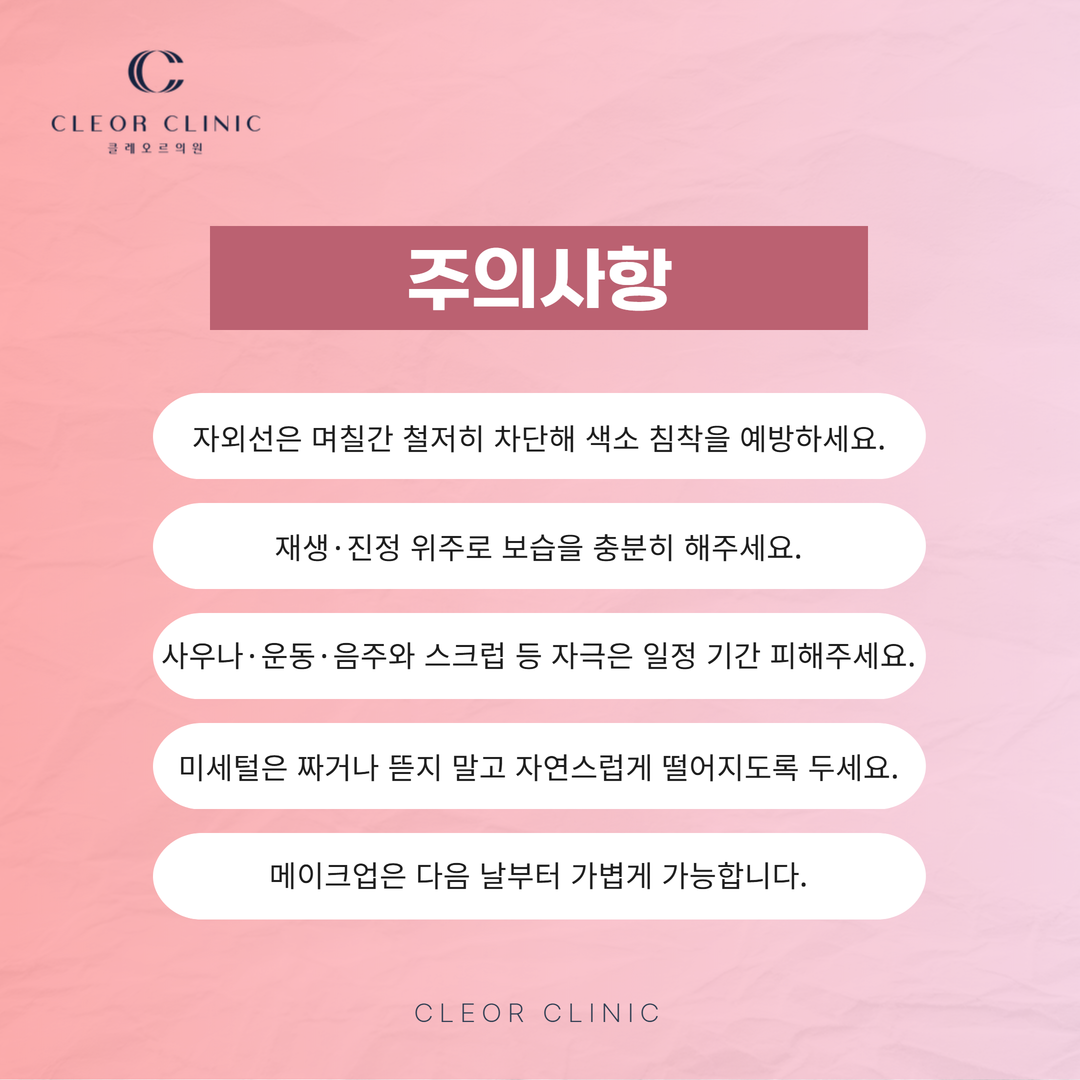
⚠️ Post-Treatment Precautions
While the recovery burden is low,
it is best to care for the area gently for a few days.
Sun Protection
For a few days after the procedure, melanocytes are more sensitive than usual.
Exposure to UV rays can cause hyperpigmentation,
so please apply sunscreen thoroughly.
Moisturizing and Soothing
For a few days after the procedure, focus on using
soothing and recovery creams for gentle care.
Reducing Irritation
On the day of the procedure, please avoid saunas, hot tubs,
strenuous exercise, and alcohol.
It is recommended to stop using scrubs, peeling products,
or strong cleansing devices for about a week.
Do not squeeze or peel
For a few days after the treatment,
fine hairs may be pushed out of the pores.
Do not squeeze them with your hands or peel them off with a nose pack.
Allow them to fall out naturally,
or light cleansing will suffice.
Makeup
Light base makeup is possible from the day after the procedure.
However, focusing on soothing on the day of the treatment will aid recovery.
Temporary Symptoms
Mild redness and slight tingling may occur immediately after the procedure.
These usually subside within a few hours.
However, if you experience persistent pain, blisters, oozing,
or any discoloration, please visit the clinic immediately for an examination.
❓ Frequently Asked Questions
Q. Are all fine hairs removed in one session?
A. Due to the hair growth cycle,
it is difficult to address all hairs in a single session.
The extent of change often becomes clear
after 3 or more cumulative sessions.
Q. How much pain is there during the procedure?
A. Since numbing cream is applied beforehand,
the pain is generally manageable for most people.
Areas where nerves are concentrated, such as the tip of the nose,
may experience momentary stinging.
Q. Can I see the fine hairs coming out after the procedure?
A. For a few days after the procedure,
you may see fine hairs being pushed out
of the pores.
During this time, do not squeeze or peel them with your hands;
simply let them wash away naturally during cleansing.
Q. Do pores also get smaller?
A. While the primary purpose of the treatment is to manage fine hairs,
some people experience a cleaner appearance of the pores
as the hairs and dead skin cells clumped inside
are cleared out.
However, this procedure does not guarantee a change in the actual size of the pores.
Q. Is the effect permanent?
A. Laser hair removal is a procedure closer to
"permanent reduction" rather than "permanent removal."
Since hairs from untreated cycles may grow back
or fine hairs may settle in new pores,
maintenance treatments are often required.
Q. Can I receive this along with other treatments?
A. It is sometimes combined with pore or pigment care treatments,
or procedures like skin boosters.
Customized combination plans are provided during the initial consultation.
Q. What are the potential side effects?
A. Temporary redness, slight swelling, thin scabs,
and temporary pigment changes may occur in the treated area.
As rare cases of burns, blisters, and hyperpigmentation have been reported,
pre-treatment consultation and post-treatment monitoring are important.

If the black dots on your nose tip and glabella
do not disappear even after squeezing,
they may be Trichostasis Spinulosa rather than blackheads.
Approaching conditions with different causes
in the same way can lead to slow results
or even cause the pores to widen further.
If you are considering Hongdae Facial Hair Removal,
it is best to first identify the nature of your black dots
and then determine the treatment area and number of sessions.
At Cleor Clinic Hongdae Branch, in addition to the Fotona StarWalker,
we also operate the GentleMax Pro Plus.
The GentleMax Pro Plus is
a dual-wavelength laser device from Candela (USA),
featuring both 755nm Alexandrite
and 1064nm Nd:YAG wavelengths,
making it versatile for various skin types and hair thicknesses.
Depending on the area, hair texture, and skin type,
we design a treatment plan using the most suitable device
between the Fotona StarWalker and the GentleMax Pro Plus.
If you are concerned about black dots on your nose or glabella,
please feel free to contact Cleor Clinic Hongdae Branch.
※ This content is intended for general informational purposes; results may vary depending on the individual. Side effects may occur, so please consult thoroughly with medical staff during your visit.